hello fellow heat exchangers,
my name is Cath and I recently completed an MA at UWE where I met Elizabeth Turrell. Her enthusiasm for enamel led me to experiment on steel as a drawing substrate and consequently I became fascinated in applying enamel to found objects.
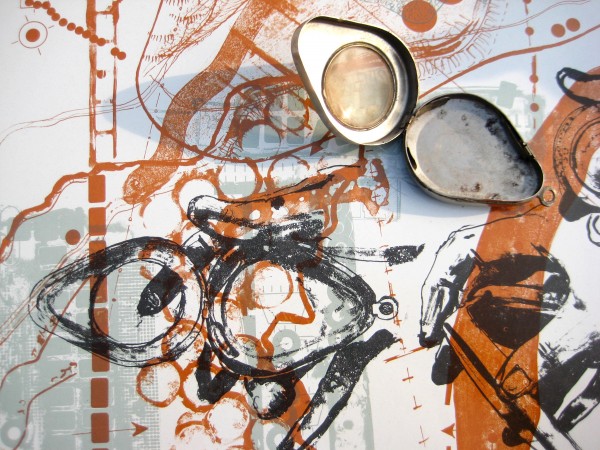
I am currently researching coal-industries within Wales, exploring a means of translating and recoding history to relate a duality between terrible working conditions in a coal-pit with the solidarity of social communities. I am motivated by a sense of mortality positioned in the moment, the power of ordinary objects to convey a sense of humanity, and notions of morality within shifting, ideological perspectives.
In making cast-iron replicas of utilitarian mining-artefacts I hope to simultaneously create an illusion of authenticity with sculptural solidity – like a paperweight, to hold firm or make resilient a snap-shot of history. Through a remnant object I want to capture the implication of what was there seen through what remains. The heavy material acts as a metaphor for weight of subject matter, giving the impression of permanence to a forgotten industry.
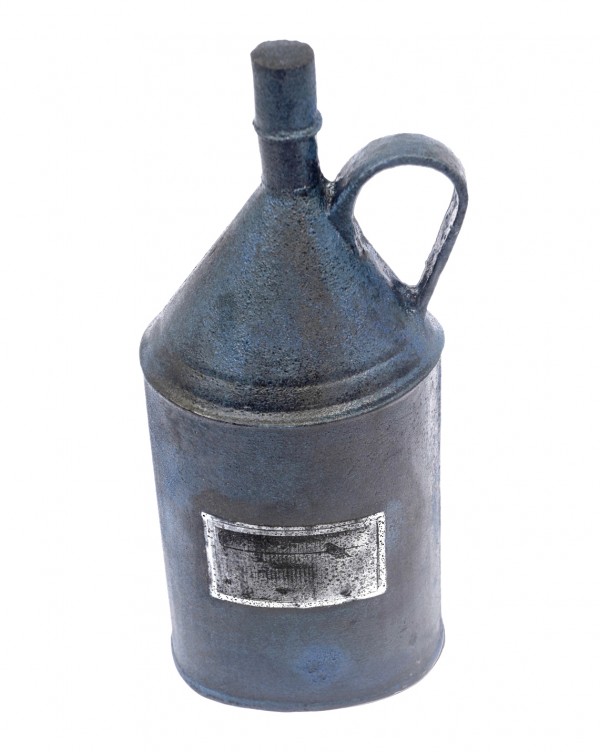
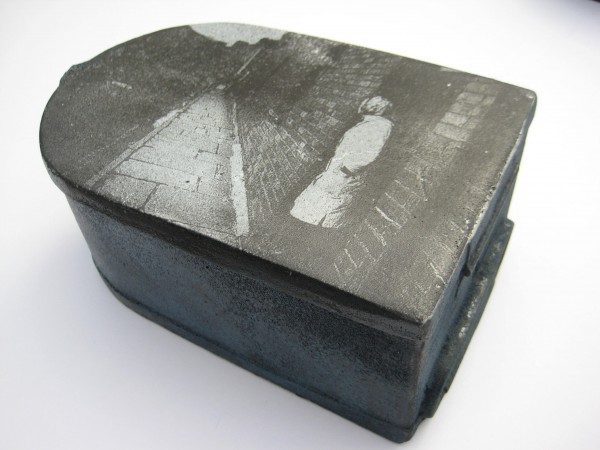
Through my experimentation with enamel I have had some partial success using decals to apply documentary photographs to the 3d cast objects. But I have also discovered infinite technical problems resulting from the porous nature of iron and defects in the material I have access to: my inability to solve these problems has resulted in an interest to take advantage of them: I hope to use this Heat Exchange opportunity to develop a more exploratory approach to enamel on iron, to embrace the learning possibilities of a dialogue exchange.
I am so excited to participate and very nervous about my limited time. This opportunity is particularly significant to me because it holds my focus on enamel processes and demonstrates my need to create a new studio environment. I look forward to hearing how everyone’s response to Heat Exchange unfolds…

Catherine Fairgrieve
Catherine works across discipline boundaries, excited by the potential of combining traditional processes with new technologies. She is an artist and educator, and lives in Wales.
Cath, the idea of incorporating the imperfections has really grabbed me, as it likely will others in the project. I now remember discussions about the use of cast iron in the studio – but not the details, of course. Do you have to fire once before you put a grip coat on, or is it clean up (sandblast?) then grip coat on first firing?
Hi Melissa,
my goodness – I am blogging Australia – this is really exciting as I don’t even have a mobile phone yet! I feel like I’ve joined the techno revolution at last!
To enamel on iron you have to anneal first for about 30 mins at approx 900 degrees. this seems to settle some of the gas in the metal. I then sandblast and spray enamel without using a grip coat because my grip coat just doesn’t seem to work at all: I wonder if I have brought it up to a high enough temperature.
The problem with my iron is that the pieces are very thick and the metal retains its heat so it is easy to over cook. But I am seeking help from an industrial company in England who are very generous with their advice. They reckon you can only get away with 3 firings before gasses re-emerge in the metal and you have to start the whole process over again!
From my photos you can see imperfections on the surface where the metal has bubbled – it was fortuitous that the decals were reproduced from old photos! And I am interested to push this further. With a very thin white coat iron speckled patterns emerge, tracing how the metal pours into sand moulds. But with thin enamel curious salts emerge after a few weeks as moisture is reabsorbed by the iron – probably not helped by living in Wales where the atmosphere is very damp!
Its all one big learning curve for me – especially since I can’t just squeak for help from Elizabeth! I also don’t own a kiln although I have access to kilns at work.
Thanks for blogging me – I feel like a thoroughly modern Millie –
best wishes, Cath
Thanks Cath, that’s brilliant! (and just quietly, Thoroughly Modern Millie is one of my all time movie favourites – many an afternoon was spent re-enacting scenes with my sisters.) I love the idea that you can see the traces of how the metal was poured. Amazing!
I know what you mean about not being able to ask The Guru for advice – I’ve had to look through notes and rely on half remembered conversations. Thankfully you’ve just filled another gap for me 😉 I’d better write that down now in fact…
m
I love the idea of imperfection too; it does grab me, but I also find it so hard to embrace in my own work, where I would like it so much to be perfect ( but of course it never is) We had many conversations about this, which I would love to continue. Maybe we could do a ‘pairing’ and swop small pieces of work, laser cut and poured iron?
love Beate
hi Beate,
I would love to swap some small pieces of work to collaborate in some experimental way – to push the accidental nature of experimentation. I am busy making moulds to pour iron in January so could have some metal ready by early February. Could we combine an effort by linking it with your reading material?
I really look forward to talking about this again….love Cath