making a start

Heat Exchange presents a moment of significant change in my practice as I start to address a different working environment and routine, and I am fascinated to hear how others of you have navigated the upheaval of changing studios.

In recent years I have commandeered a big kitchen table for drawing, and chaotically processed work on the attic floor and back yard. My choice of materials and processes has always followed concept and I defined myself as a fine artist distracted by a teaching job. Eventually I resolved my work-life balance by going back to college to study an MA. During this intense period I explored many new processes including enamel and most importantly identified myself as a ‘maker’: an applied artist using drawing with objects. So I realised a context for my work but now need a different studio fit for purpose.

Today I am once again constrained by my day job, trying to juggle teaching with exhibitions and grant applications. I have learnt that risk-taking is necessary for inspiration: this exhibition acts as a trigger for change, a transference activity to instigate a new approach to work and lifestyle.

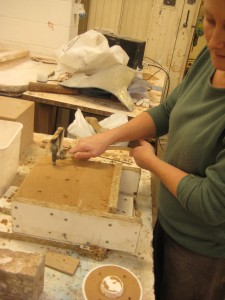
This holiday I finally found time to instigate my project by working at college in lieu of a personal studio
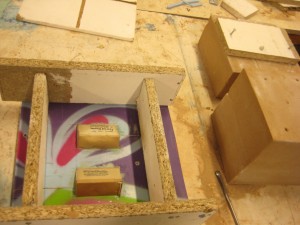
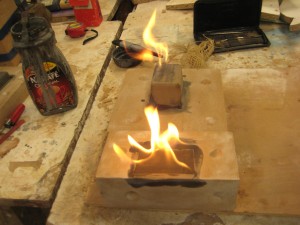
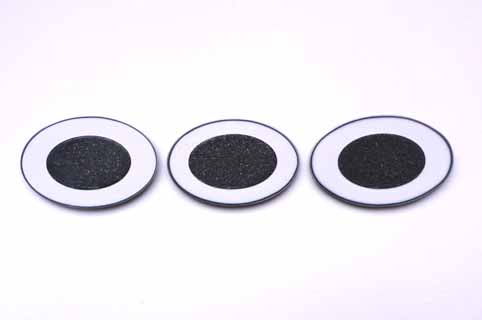
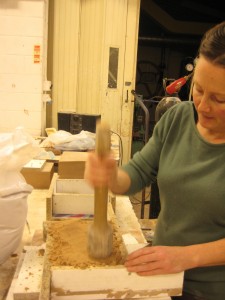
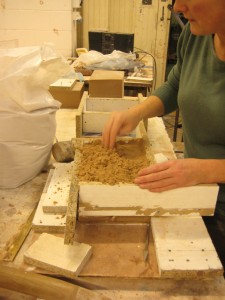
Here are some photos of work in progress: I have taken old mining artefacts as forms for sand casting – piece moulds are made using sand hardened with carbon-dioxide. To complete the sand-surface in preparation for molten iron it is ignited with a solution of graphite powder in alcohol. I like the fact that several heat exchanges occur throughout my project during mould making, melting of iron, and enamel application, and through transference the replicated objects are rendered dysfunctional to become vehicles for reverie…
with best wishes for the New Year, Cath

Catherine Fairgrieve

Catherine works across discipline boundaries, excited by the potential of combining traditional processes with new technologies. She is an artist and educator, and lives in Wales.
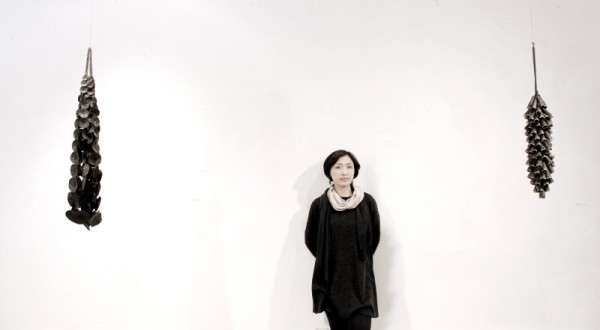
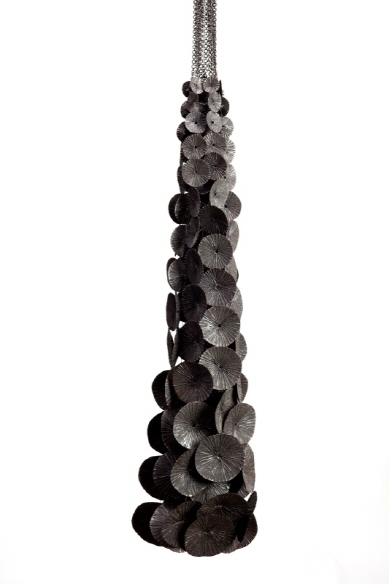
“Connection” Series….

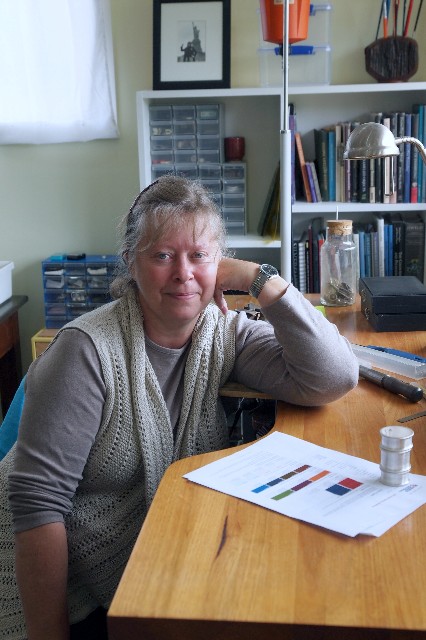
Hello…My name is Heejin Hwang and now I am studying Art Metals at University of Wisconsin-Madison and will be graduating with an MFA next May.

I have been more focused on enameling since taking Helen Carnac’s class-Mark Making in Enamel-at Penland School of Crafts in 2010. What first attracted me to enameling was surface quality that I’d like to work with. Thus, the majority of my current pieces have sensuous surfaces that offer meanings that satisfy intellectually as well as aesthetically.

My work is about the tension between structure and sensuality. I am interested in framing female identity through the lens of beauty, control, dignity, strength and vulnerability. .As multiple units complete a perfect structure, the whole becomes animated and my jewelry comes to life. Only when the body ornaments are perfectly installed on the wearer, does an emotional and structural rapport begin. 

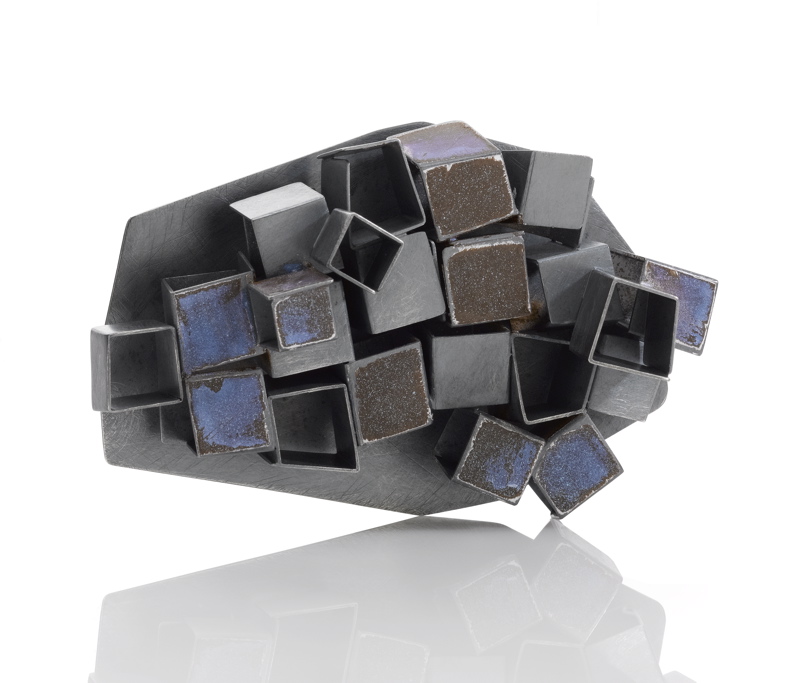
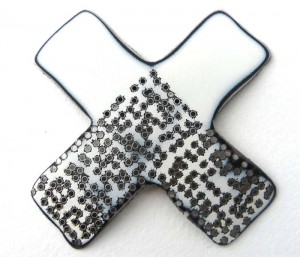
Steel sheet, steel wire, enamel, ground rock / 2010

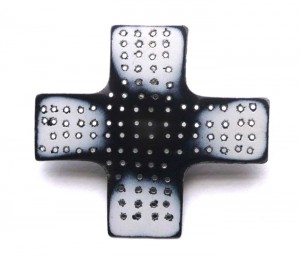
Steel wire, enamel, ground rock / 2011

Steel wire, enamel, ground rock, hand-dyed yarn / 2011

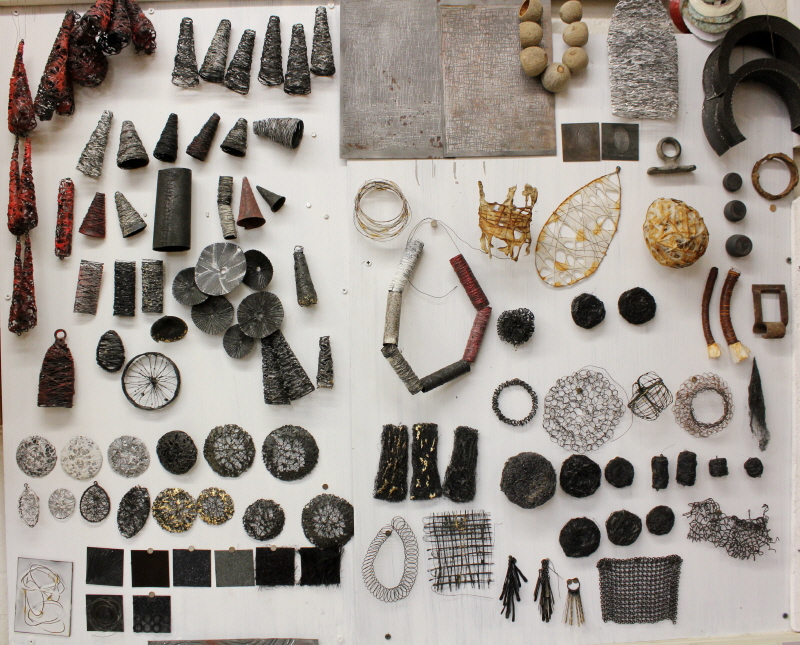
One of my favorite activities in studio is to look at my lovely samples for a while sitting in front of the bench, which is the most basic of my creative process.

My sample board

Everyone, good luck with your project!!

Heejin Hwang

featured in our first Heat Exchange exhibition in 2012.

From Way Over Here…

Hello! My name is Amy Tavern and I am a studio jeweler.  I live and make my work at the Penland School of Crafts in North Carolina where I have been a resident artist since January 2009. Over the past three years I have done lots and lots of exploration of my medium, other materials, and process.

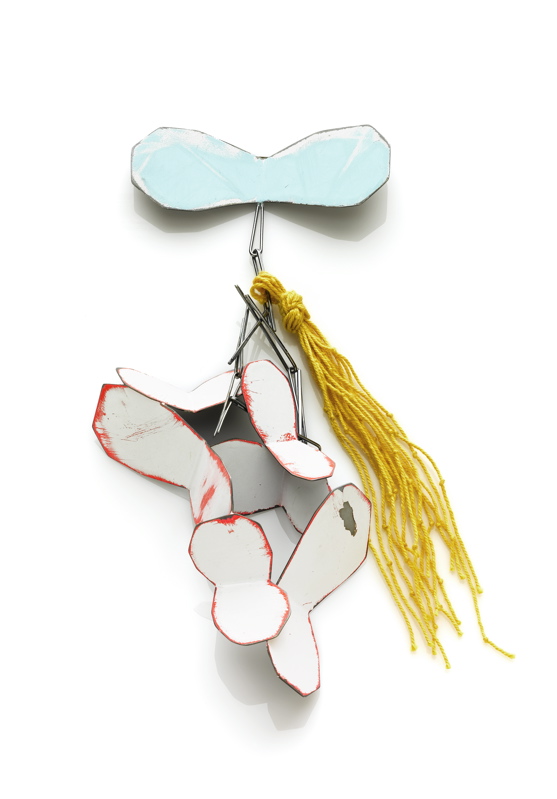
Bow Cluster Brooch with Tassel. Sterling, spray paint, cotton string.

The work I make primarily involves spray paint on sterling silver. I layer different colors and then once the paint is completely dry, I scratch the surface with files, a scribe, and heavy- grit emery paper. My use of spray paint comes from my love of graffiti, the scratching comes from my love of distressed surfaces and signs of age.

Leaf Crystal Brooch from Fabricated Memory: Jewelry Box, 1980. Sterling, spray paint.

Most recently I completed a large body of work for my first solo exhibition. The work was based on my personal history with jewelry. You can read my artist statement here and view the two collections here and here.

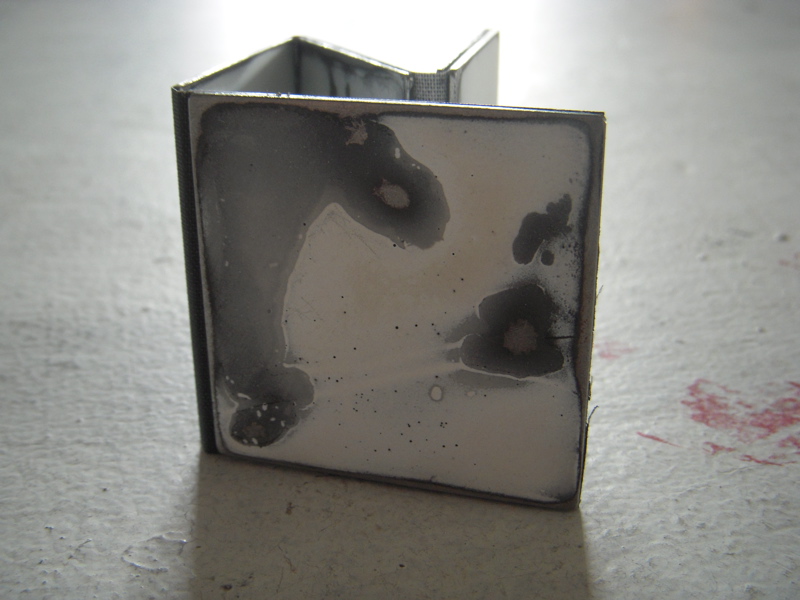
The front cover of my enameled book. Enamel, steel, book cloth.

Although not an enamelist per se, I have done some enameling and have wanted to focus more attention on it. During the summer I made an enameled book while Elizabeth was teaching a class here at Penland. Something went “wrong” during a firing of one of my steel pages, but Elizabeth suggested I look at it in another way. This “mistake” will be my starting point as I begin work for this exhibition.

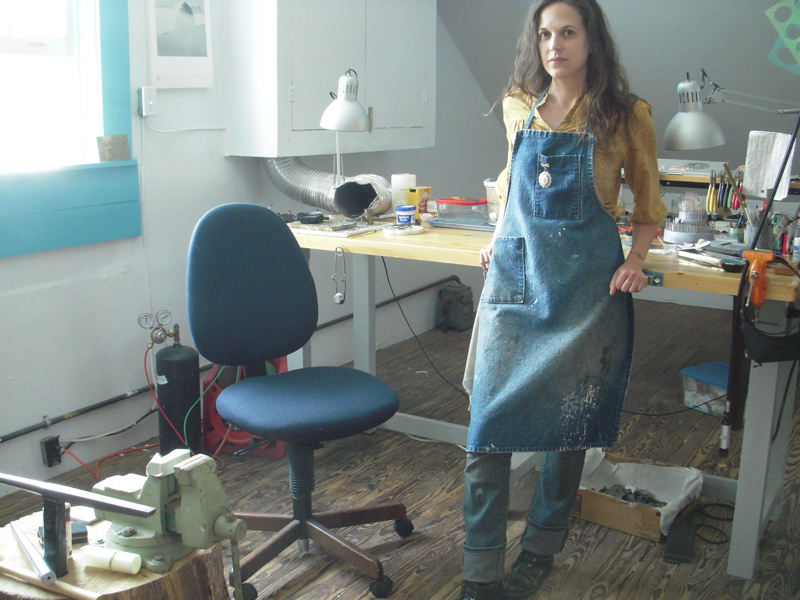
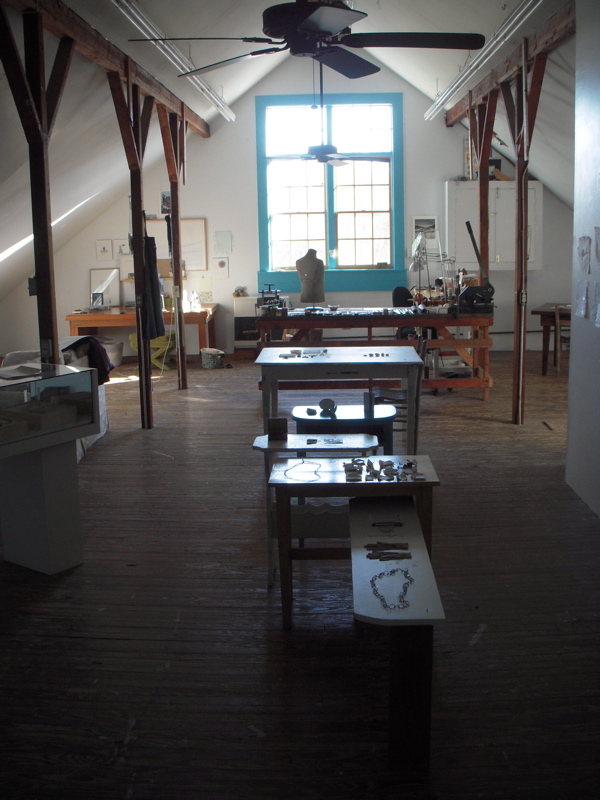
My studio.

Thanks so much for reading.

Amy Tavern

featured in our first Heat Exchange exhibition in 2012.

Following a line of thought

In my new Studio

In Australia right now, you would expect some roaring summer temperatures. Not so! We are having the coolest summer ever I think. Fortunately I have been firing so my kiln is warming my studio very nicely.

I would like to tell you a little about an adventure I have been having over the last few years. I have been fortunate to make a delightful connection in Japan through contributing to some International Exhibitions there. In 2007 I received a grant from the Australia Council to go and study Japanese enamelling techniques with a gentleman who has become my mentor and dear friend. Mr Sakurai is now eighty eight years old and has worked for his company, the Ando Cloisonne Company, all his life. So you can see he has a depth and breadth of experience and understanding that is truly impressive.

I have been back to study with him three times since then and on each visit I have concentrated on a particular technique. In my practice, I wanted to be able to work on a larger scale. I completed a post graduate year of studies in 2006 where I worked on larger forms utilising low firing temperatures to create richly textured surfaces. The image below is from a grouping of work based on bushfires. As you know, we have plenty of fierce bushfires in Australia and after one event near my old house, I went out and photographed the ravaged areas over a few months. It is amazing to see the devestated blackened and ashen ground gradually give way to the tiny and delicate green and ruby shoots of new growth.

Walking with Fire 2

Now, my Japanese studies have allowed me to return to using cloissone and start exploring it on smaller vessels.

There were two techniques I studied at first; Yusen Shippo and Doro Shippo. Yusen Shippo is really the same as Cloisonne work (shippo being enamel). I have used Cloisonne for years, though now I was learning to apply the wires to a three-dimensional object. This was quite challenging and I learned many interesting tricks. The second technique, Doro Shippo, is actually about the enamel. That is, Doro is a primitive form of enamel that has a rather stone-like quality when fired. It is pretty finely ground, so when mixed with water, it’s quite like working with mud!

I have started working on two brooches using the Doro Shippo. As I have had quite a break from work while re-establishing my studio, it takes some time (and often some dud enamelling) before I get in the zone again. So, start small and work slowly. Don’t make assumptions!

Two Brooches using Doro Shippo; ready for the second firing


Barbara Ryman

featured in our first Heat Exchange exhibition in 2012.

Welcome to my world

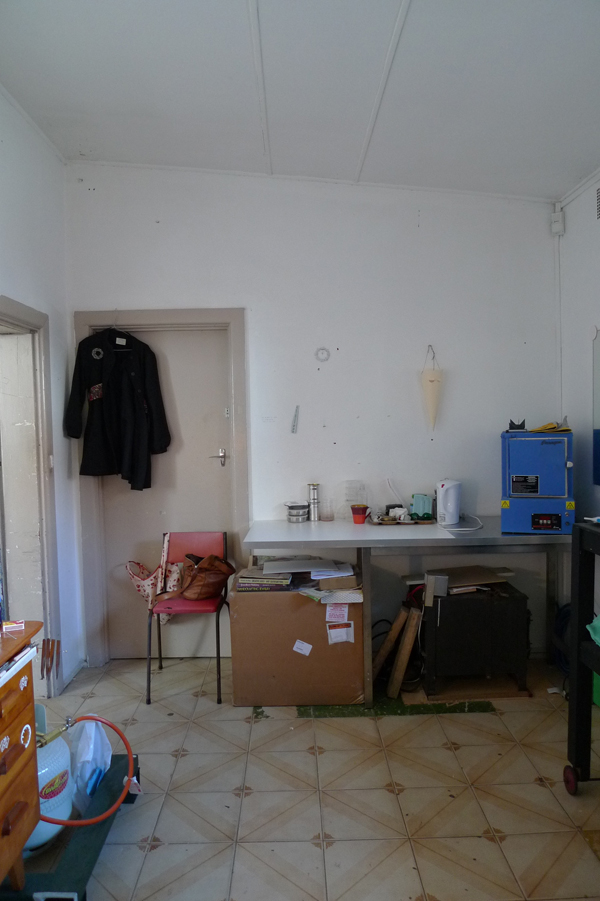
So, I never did introduce you to my studio…

The prep bench and kiln, with an inherited old clunker of a kiln hiding out below (to the right)...
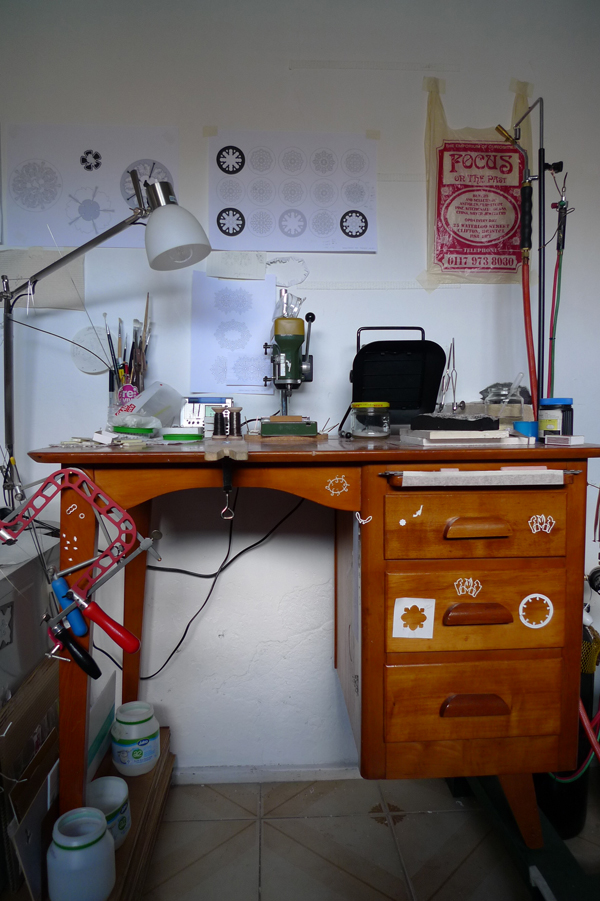
My sorry excuse for a bench, cluttered with tools and pasted with sawn-out, adhesive backed Cad drawings
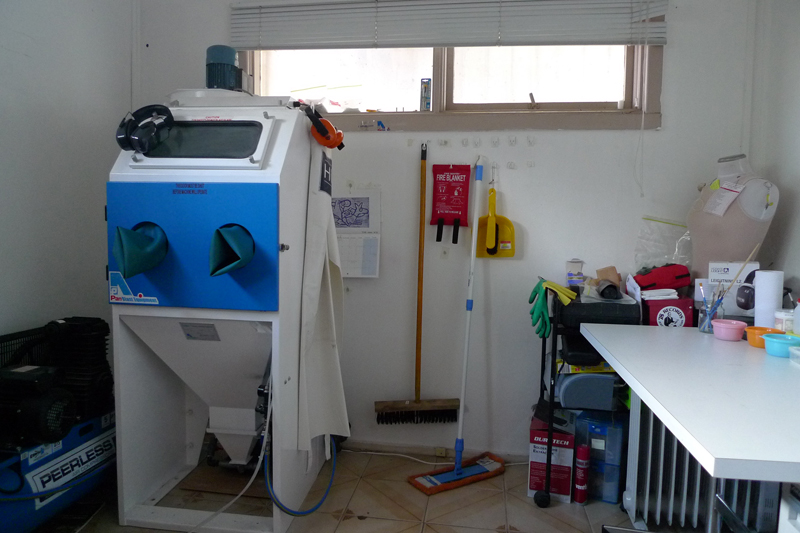
My sandblaster. My 2nd favourite tool, and a great aid for wet-process enamelling on steel. (First favourite is the saw frame - there was only 3 in that last photo, but I think I own 5...)

Melissa Cameron

Melissa is a jewellery artist from Australia living in Seattle in the US. Her works can be found in the National Gallery of Australia as well as the Cheongju City Collection in South Korea. Her enamel works typically display subtle enamel incursions amidst precise laser cut stainless steel layers.

Traces

Hello,

my name is Agnes and I live in Nürnberg, Germany.

After taking a silversmithing apprenticeship, I frequented for 3 years the Academy of fine arts in Munich, and for 1 year the Academy of fine arts in Nürnberg.

I began to use enamel in Munich around 1998; since then this materiel was never leaving me. When I think about any theme I’m working on, the word “traces” comes into my mind. I’m interested in surfaces, how they change while time passes, how patina develops …

When I’m grinding the enamel-surface, these grinding-traces speak to me.

Late, but not lost!    Agnes


Agnes von Rimsha

featured in our first Heat Exchange exhibition in 2012.

Surface & Substance

Surface & Substance International Contemporary Enamel Jewellery exhibition curated by Jessica Turrell – Ruthin Craft Centre  Denbighshire, Wales. 19 November 2011 – 15 January 2012
Brooches – Elizabeth Turrell

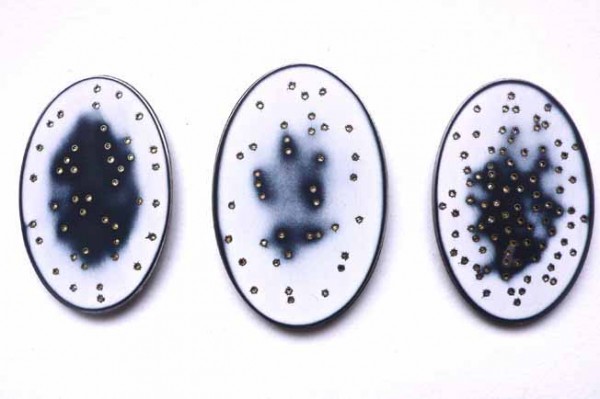
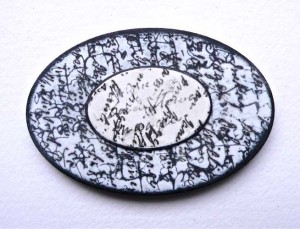
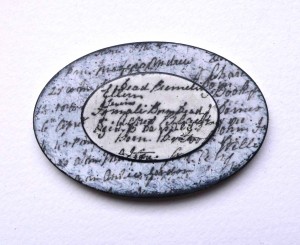
These wearable pieces are forms of an in-memoriam marker, a silent message that may elicit a feeling of melancholia or disquiet. I hope they may encourage conversation. In the pieces that use image and text – there is more than you see – parts are hidden.

Materials and process are a significant part in the thinking and making of this work – that chemical bond of glass on metal. It is the inherent qualities of this material that attracts me at a sensory and aesthetic level.

Using thin white pre-enamelled steel – a functional factory produced material – gives me a bland surface with none of the usual preciousness associated with enamelled jewellery. I am entranced by the different qualities obtainable by piercing and altering the white surface to reveal the qualities of the steel substrate. I like the limitation set by this single material.

These pieces are an attempt to transform and extend the traditional concept of vitreous enamel on metal: the glassy, the decorative, and the perfect surface. This material seemed best suited to express and clarify my intentions.


A lot of drawing

Just like you, Melissa, I have been fascinated by the black ‘halo’ surrounding liquid enamel on steel and many pieces have been built around it, polishing the surrounding steel back to a silver surface. It is so very frustrating though that sometimes the ‘halo’ is beautiful and jet black, at other times thin and frayed. My theory is that it depends on the particular batch of steel, the iron content, how it is rolled etc. (And of course, how I feel when I work and apply the enamel)

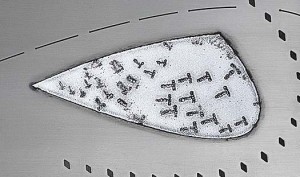
The below is an example of a piece from ‘Playing with Fire’, perfect edge.


I have never been able to achieve the same, although I am trying to embrace the serendipity of the kiln and the material. The results for Drawing, Permanence and Place were rather different.

And a close-up:

Any advice would be great.


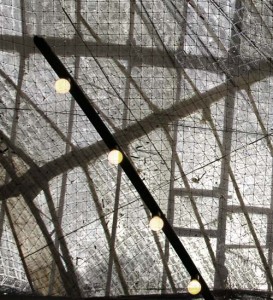
I have begun drawing, drawing, drawing. First on paper, then in Illustrator. I have been looking through my photographs from the arcades in Paris, still loving the strange netting on the roofs and curved ceiling lights.


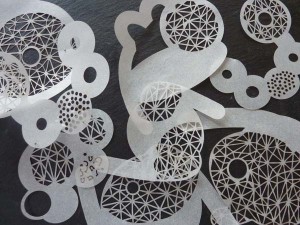
I am ‘circling’ around many ideas; at the moment I am thinking of an installation of many multiples. I will write more about the concepts underlying the work in a future blog, for now I would like to give a brief visual flavour of what i am thinking.

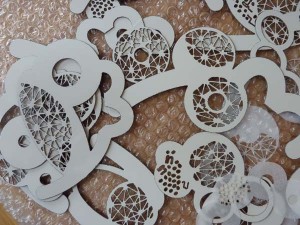
Here are my first experiments, in paper:


and water jet cut in pre-enamelled steel. They will change quality once they are ‘properly’ enamelled.


Beate Gegenwart

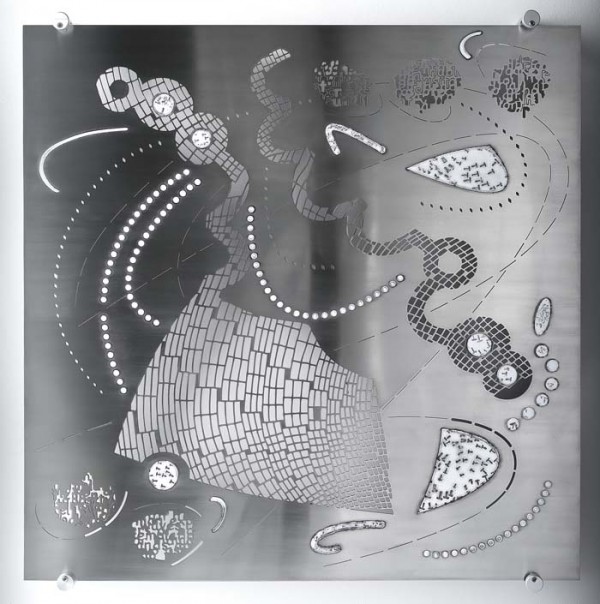
Beate Gegenwart is an enamelist and educator originally from Germany who lives and works in Wales, UK. Her studio is located on the beautiful Gower peninsular and she is a Honorary Research Fellow at Swansea School of Art (University of Wales Trinity Saint David). Her large enamel works exhibit an expressive interplay between polished stainless steel and fields of delicately applied and inscribed enamel. She is currently supported by a major production grant from the Arts Council of Wales.
Drawing a brooch

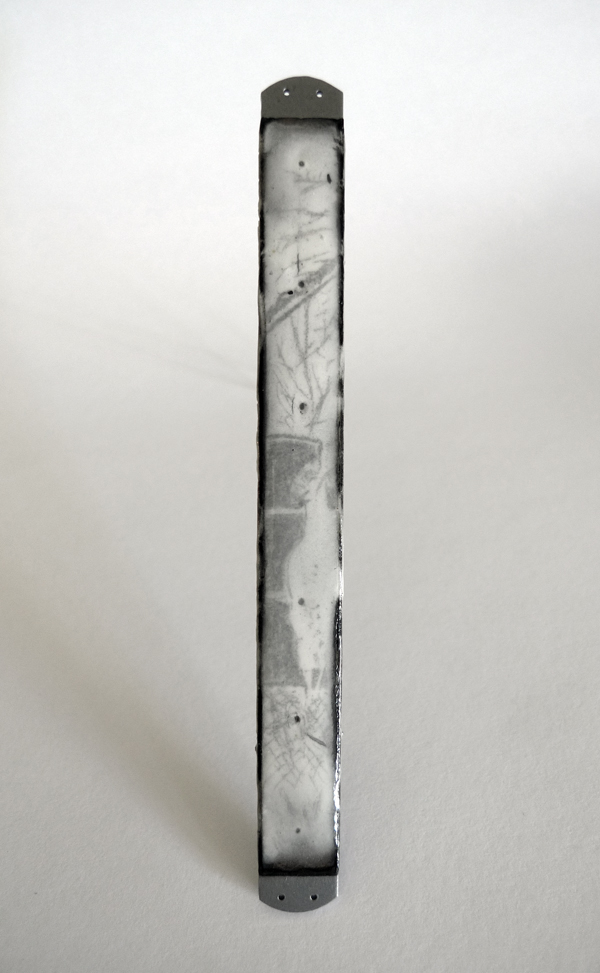
My enamelled test piece, Slivered Coaster. Melissa Cameron, 2011. Mild steel, graphite, vitreous enamel, 925 silver fixings

This is an enamelled piece that I made as a response to a recent work, and as a test piece for my works for the Heat Exchange project. Thus it has some faults, but has also proven to be quite instructive in determining what I’m after, especially in terms of the shape of metal substrate I’m seeking to use for my current works-in-progress.

I’m going to analyse it, for my own reference, (something I guess I would normally do, but not ‘out loud’ like this), starting with the faults, as I see them.

– The edges need better finishing – I’ve ordered some diamond abrasive pads and would ideally smooth the edges to be consistent. I actually like the black frame line too – but I think I have to work at making it a little more consistent also.

– The line of dark dots down the centre – these were intentional as they mark holes in the metal that the enamel has covered, and were kept to match the work that this piece was responding to. They seem out of place in this work however, so I would not be working to cultivate them if I made this piece again. (Having re-read this, and looking again at the image, I’m now wondering about my Descartes connection, and what I have drawn so far. In some instances maybe they will stay…)

– The clarity of the drawn image – It’s not clear what it is, and I think this results from the choice of image combined with its use in such a tight area.

The things that I like about this work

– The shape and its potential omni-directionality

– The graphite drawing – there is something very beautiful about the overall materiality. Several people have mistaken it for mother-of-pearl, which is interesting. I made another brooch on the same day, but the markings in graphite are less interesting/evocative.

– The combination of sandblasted metal + enamel – Shiny versus matte. Contrast is good.

That’s a lot of feedback, from one small piece, 105mm x 10mm.

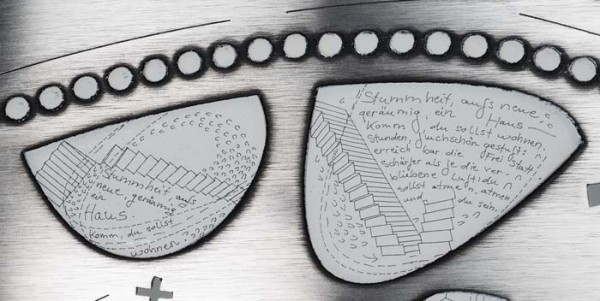
I’m in the process of drawing patterns, that I will have laser-cut in stainless steel. This is the first time I’ve made these drawings with enamel in mind. It’s a long process, so it still feels like I’m a long way from doing any enamelling.


Melissa Cameron

Melissa is a jewellery artist from Australia living in Seattle in the US. Her works can be found in the National Gallery of Australia as well as the Cheongju City Collection in South Korea. Her enamel works typically display subtle enamel incursions amidst precise laser cut stainless steel layers.