Sampling

I started the New Year with a number of projects on. Like Jessica and Elizabeth Turrell I am making work for an international show in Munich at Gallery Handswerk, ‘Enamel -a Renaissance’. I planned to build on the range of new brooches I made for the ‘Surface and Substance’ exhibition that Jessica curated so beautifully and which closed this January at the Ruthin Gallery in Wales. The new pieces I made for this show were brooches in silver and enamel that apply textile surfaces to the shell metal and augment them with pattern, movement and ultimately colour.

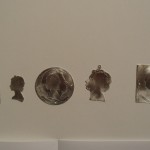
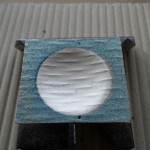
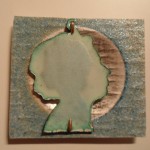
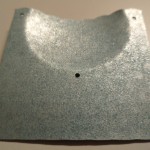
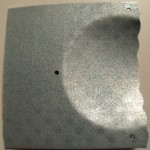
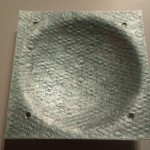
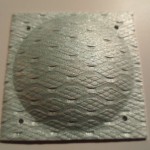
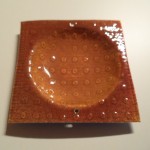
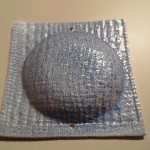
One other project has been making a piece for a jewellery show organised by the Association for Contemporary Jewellery to celebrate the Queens Royal Jubilee. An idea I had for this was to work with some diamond dust. Inspired by Elizabeth’s work fusing grit into her enamel surfaces I ordered industrial diamond dust and have been experimenting on how this material behaves with enamel. It has been wrought with issues of pinging off and shedding.

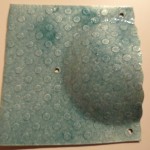
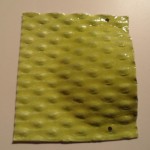
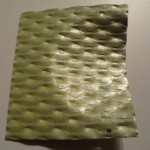
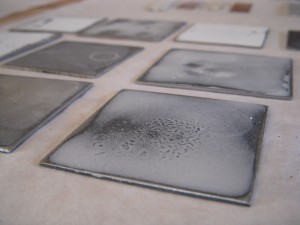
I now have several samples (the good, bad and the ugly, as I call them). It has been great to have these projects on and Heat Exchange turning up the heat too.  I hope to have some exciting new material to introduce into the mix here too. I can’t say too much more at the moment as it isn’t quite there yet…..(sorry to be a bit mysterious here)

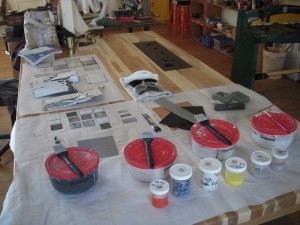
Here are images of all of the above that are in this mix:
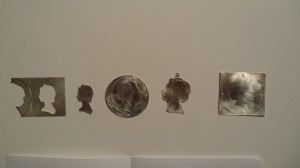
A series of Queens heads cut out for the Jubilee project to test. (the queen's head is one of the most popular names for a British pub, for those of you from outside the UK)

Stephen Bottomley

Stephen Bottomley trained at the Royal College of Art (1999-2001) having also studied at West Surrey College of Art and Design and the University of Brighton, with a key period working within Rhode Island School of Designs’ metal programme (USA 1998). Stephen established his first studio in 1990 in Brighton with a Prince’s Trust Grant, exhibiting his work regularly in exhibitions and at outlets like Electrum Gallery and Dazzle. He started regular associate lecturing work around the South East coast in 1992. After twelve years lecturing and leading several courses at Hasting College of Art, with the University of Brighton, he relocated to Sheffield in 2004. Between 2004-2007 Stephen divides his time between his jewellery studio and his close involvement with both academic life and the jewellery industry, being both course leader for Metalwork and Jewellery at Sheffield Hallam University and also the fourth Chairman of the ‘Association for Contemporary Jewellery’ (ACJ). Between 2007 and afour year project researching the patterns and textiles at the Fortuny Museum, Venice and a solo shows in Venice and back at Hove Museum and Art gallery in 2008, he relocated to Scotland taking the post of Head of Jewellery and Silversmithing at Edinburgh College of Art (eca). In 2011 eca become part of the world class University of Edinburgh. Jewellery is represented by the Crafts Council and held in collections by the British Museum, Royal College of Art and the South East Arts Crafts.

First Samples

I love making samples. Love. This is something I have discovered since becoming a resident artist at Penland. I have spent a lot of my time over the past three years exploring process, technique, and materials and made many, many samples. I realized the other day as I worked on my enameling what a luxury it is to be able to have the time to make samples. It really is. There are so many things we artists have to do in a day that it is challenging to carve out the time to explore. I am enjoying learning a new material and process and like making sample after sample just to see what happens if…I layer, over-fire, sand blast, stone, scratch, draw, drizzle water on a dried enamel surface, fire before the surface is completely dry. The aim is to learn and get comfortable through exploration and, ultimately, to find that distressed, messed-up, aged-looking, imperfect surface that mimics that kinds of things I am inspired by.

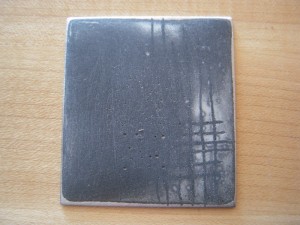
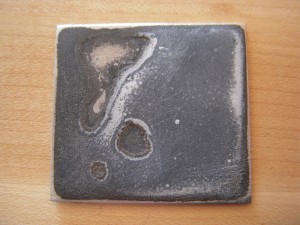
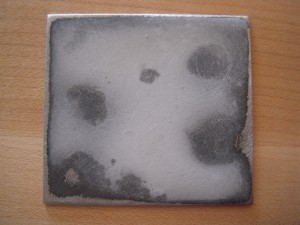
My favorite discoveries so far include incising lines on the surface of the metal as well as on the surface of the fired enamel using my flex shaft and a cutting or separating disc, over-firing, and dripped water on the surface of dried enamel. I have posted images of these findings here. The are tons more on Flickr.

incised lines, layered liquid enamel

over-firing, layered liquid enamels


dripped water, layered liquid enamels

I am really enjoying this time. Really and truly. Now I am beginning to consider the sample as more than a sample as many of them are turning out rather nicely. I hate to discard them for more “serious” pieces and so I’m thinking these samples might turn into the finished pieces. More on that later…

Thanks so much for reading.


Amy Tavern

featured in our first Heat Exchange exhibition in 2012.

new shoots…

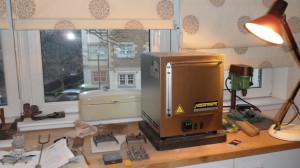
This is the new kiln a got last year from Germany. It is wonderful to work with. fast to heat up and very steady at holding its temperature.
Pride and joy. This is the new kiln I brought last year from the Nabatherm company in Germany. Bliss to use. Quick to heat up and very steady reliable heat control.We have a jewellery bench adjacent the enamelling area. In a small area we have a lot of equipment that can be brought out and set up

Stephen Bottomley

Stephen Bottomley trained at the Royal College of Art (1999-2001) having also studied at West Surrey College of Art and Design and the University of Brighton, with a key period working within Rhode Island School of Designs’ metal programme (USA 1998). Stephen established his first studio in 1990 in Brighton with a Prince’s Trust Grant, exhibiting his work regularly in exhibitions and at outlets like Electrum Gallery and Dazzle. He started regular associate lecturing work around the South East coast in 1992. After twelve years lecturing and leading several courses at Hasting College of Art, with the University of Brighton, he relocated to Sheffield in 2004. Between 2004-2007 Stephen divides his time between his jewellery studio and his close involvement with both academic life and the jewellery industry, being both course leader for Metalwork and Jewellery at Sheffield Hallam University and also the fourth Chairman of the ‘Association for Contemporary Jewellery’ (ACJ). Between 2007 and afour year project researching the patterns and textiles at the Fortuny Museum, Venice and a solo shows in Venice and back at Hove Museum and Art gallery in 2008, he relocated to Scotland taking the post of Head of Jewellery and Silversmithing at Edinburgh College of Art (eca). In 2011 eca become part of the world class University of Edinburgh. Jewellery is represented by the Crafts Council and held in collections by the British Museum, Royal College of Art and the South East Arts Crafts.

brooches realised

I’ve finally got those images that I promised in my last post.

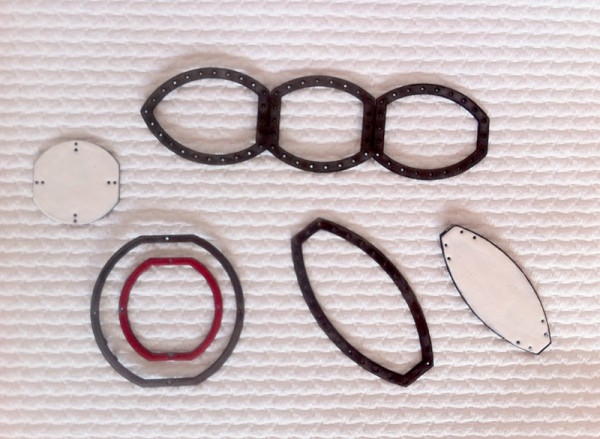
This is those same pieces of metal from the last photo, but enamelled! (Well, most of them, the insets of the big brooch at the top are m.i.a. since they weren’t enamelled yet.) This being a progress shot, none of the pieces are finished, as the white ones were all primed with a mix of clear + porcelain slip for some drawing action.

If you look close (or click on the image for the bigger version), you’ll also notice that the red piece is pinging at the holes. To remedy this I had to water everything down, doing a much thinner layer of clear, and two very thin coats of red. This time it’s totally stable, but beautifully shiny too!

To clarify, these pieces are all definitely stainless steel (excuse my mixup in the comments of the last post), with 925 silver fixings soldered with IT solder onto the backs, so are enamelled on one side only.

I’ve finished two of these pieces, while the third was a bit more tricky, but is now enamelled and awaiting assembly. That was the one that pinged the red layers. The centrepiece of that brooch (top left) didn’t appreciate the level of layering around those eight little holes, so rather than drawing in graphite, which involved two layers of enamel below and above it, I used a scraffito technique through an unfired layer of white as it required fewer. If I was a better enamellist I’m sure the graphite would have worked fine…

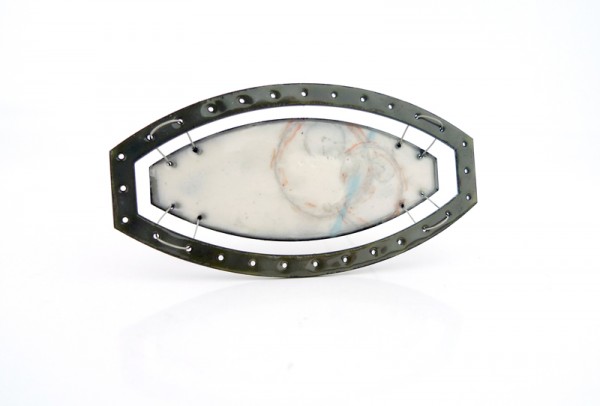
I have also finished a neckpiece that has an enamelled centrepiece, but more on that later. Here’s what the bottom right pieces look like assembled.

Melissa Cameron, Blue Radical Axis 2012. 65mm x 33mm x 10mm

Melissa Cameron

Melissa is a jewellery artist from Australia living in Seattle in the US. Her works can be found in the National Gallery of Australia as well as the Cheongju City Collection in South Korea. Her enamel works typically display subtle enamel incursions amidst precise laser cut stainless steel layers.