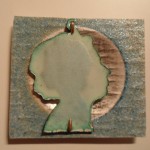
I started the New Year with a number of projects on. Like Jessica and Elizabeth Turrell I am making work for an international show in Munich at Gallery Handswerk, ‘Enamel -a Renaissance’. I planned to build on the range of new brooches I made for the ‘Surface and Substance’ exhibition that Jessica curated so beautifully and which closed this January at the Ruthin Gallery in Wales. The new pieces I made for this show were brooches in silver and enamel that apply textile surfaces to the shell metal and augment them with pattern, movement and ultimately colour.
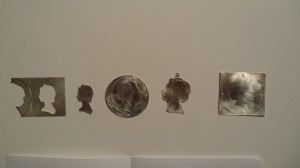
One other project has been making a piece for a jewellery show organised by the Association for Contemporary Jewellery to celebrate the Queens Royal Jubilee. An idea I had for this was to work with some diamond dust. Inspired by Elizabeth’s work fusing grit into her enamel surfaces I ordered industrial diamond dust and have been experimenting on how this material behaves with enamel. It has been wrought with issues of pinging off and shedding.
I now have several samples (the good, bad and the ugly, as I call them). It has been great to have these projects on and Heat Exchange turning up the heat too. I hope to have some exciting new material to introduce into the mix here too. I can’t say too much more at the moment as it isn’t quite there yet…..(sorry to be a bit mysterious here)
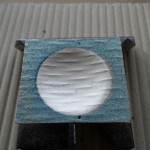
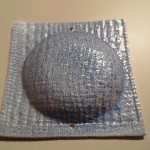
Here are images of all of the above that are in this mix:
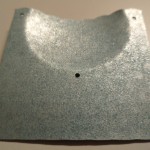
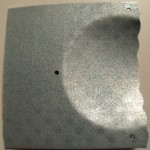
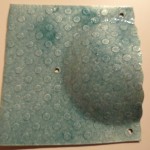
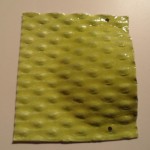
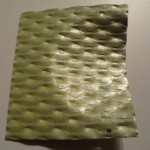
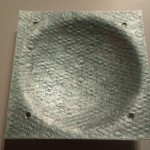
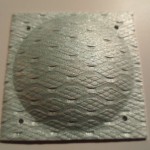
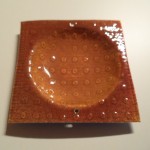

Stephen Bottomley
Stephen Bottomley trained at the Royal College of Art (1999-2001) having also studied at West Surrey College of Art and Design and the University of Brighton, with a key period working within Rhode Island School of Designs’ metal programme (USA 1998). Stephen established his first studio in 1990 in Brighton with a Prince’s Trust Grant, exhibiting his work regularly in exhibitions and at outlets like Electrum Gallery and Dazzle. He started regular associate lecturing work around the South East coast in 1992. After twelve years lecturing and leading several courses at Hasting College of Art, with the University of Brighton, he relocated to Sheffield in 2004. Between 2004-2007 Stephen divides his time between his jewellery studio and his close involvement with both academic life and the jewellery industry, being both course leader for Metalwork and Jewellery at Sheffield Hallam University and also the fourth Chairman of the ‘Association for Contemporary Jewellery’ (ACJ). Between 2007 and afour year project researching the patterns and textiles at the Fortuny Museum, Venice and a solo shows in Venice and back at Hove Museum and Art gallery in 2008, he relocated to Scotland taking the post of Head of Jewellery and Silversmithing at Edinburgh College of Art (eca). In 2011 eca become part of the world class University of Edinburgh. Jewellery is represented by the Crafts Council and held in collections by the British Museum, Royal College of Art and the South East Arts Crafts.
- Web |
- More Posts (8)
Thought I would leave my reply to your great comment on my samples post on your sampling post…so interesting that we both chose to write about samples today. Thanks for all the kind words in regards to mine. I am very interested in your use of textile patterns as texture on your metal. I have a special fascination with textiles so I am definitely drawn to this. I am also curious about your interest in changing light. I have found myself fascinated by light lately. The winter light, especially. The changes in light between seasons is apparent and I have also noticed shifts in light between the east and west coasts. (I lived in Seattle for years and the winter light there is very different from here on the east coast.)
Yes, the days vary greatly up in Edinburgh as we are quite far North. We have passed to shortest day when it was getting dark around 2.30 to 3pm and the days are getting longer now. The light is hazy and misty most days and last week we had bright sunshine and clear skies, mist, rain, sleet and even snow for half an hour. In summer it is the reverse and for a period it does not get truly dark.
When enamelling these tests over textured silver I am always struck at how varied one colour can be. Many of the images I have posted are of the same piece with either one side finely sifted with a 120mesh sieve and the other dusted 3 or 4 times in layers. The gloss interferes on a photograph, sometimes I matt them, but the reflection is so animating. They always are more fascinating in real life.
Maybe we should post images of our enamel in different light conditions? I could send you a sample and you one to me? Filming them and post video maybe better.
Amy you seem to use liquid enamel. I guess you have worked with Elizabeth, maybe Helen in Carolina? Do you apply other enamels or materials onto this surface?
Finally, does anyone work with a finer mesh than 120?
I have recently started regrinding lump enamel and want to see how fine it can be applied and how the results will change
Hi, Stephen,
Kathryn Hinton’s digital hammer sounds fantastic. What does a little machine like this look like? It would be really interesting to see a picture. Is it possible to form silver and harder metals?
Beate xxx