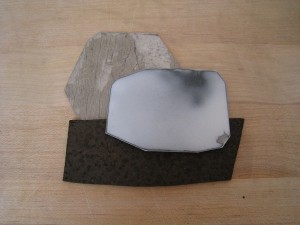
Initial Compositions

I had to take a short break from enameling to devote time to other things including planning classes and my upcoming European trip and also to teach a chain-making class. Once I returned to my assortment of samples I felt like it might be time to start considering how the pieces could work together, what steps I needed to take to move forward, whether or not I needed more samples, and so on. ( I start teaching a two-month class in less than two weeks here at Penland and I know my time will be extremely limited then. It really is time to shift from making components to making pieces.)
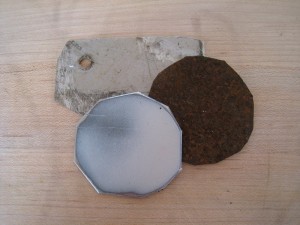
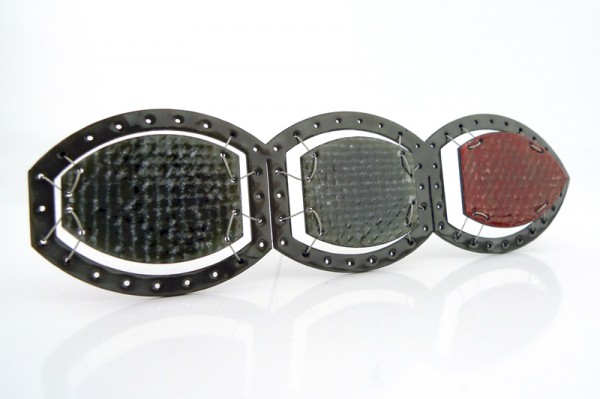
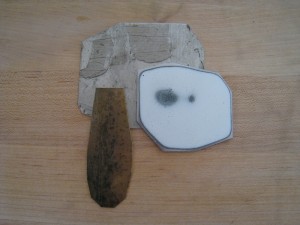
I am imagining collages or compositions of several elements: an enameled shape, some found steel, a rusty piece, a copper or brass hollow form. These pieces will be held together with rivets, bezel or tab settings, and/or some stitching perhaps. I work well with lots of elements in front of me. I enjoy the process of moving things around 3-dimensionally until a composition feels right, balanced, interesting, complete…I imagine the work as a series with similar but slightly different components. The images I have posted today are a group of sketches. I’m looking forward to seeing how things change once I begin constructing the pieces. Oh! And they will be large brooches!
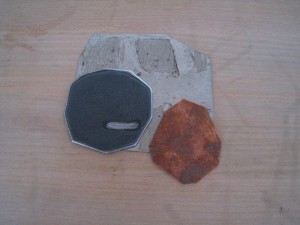
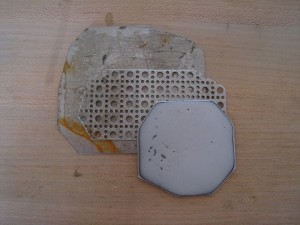
The enameling is fairly simple as you can see. It’s mostly atmospheric, but I do like the stark quality each has and what they do for these initial compositions.

Thanks so much for reading.

Amy Tavern

featured in our first Heat Exchange exhibition in 2012.

Evaporation Tests

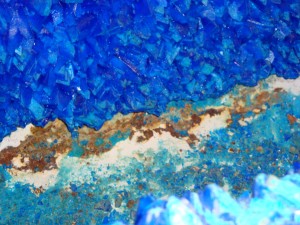
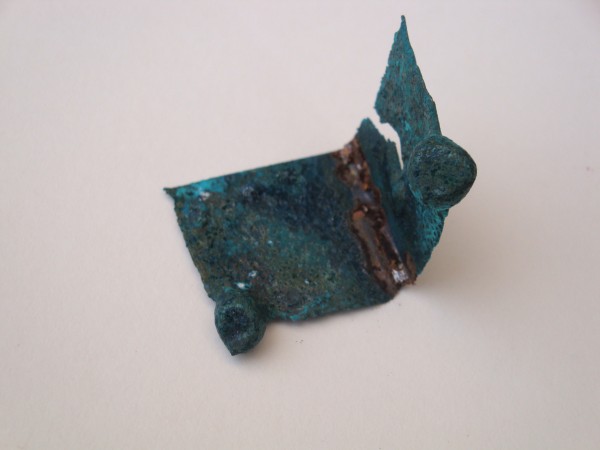
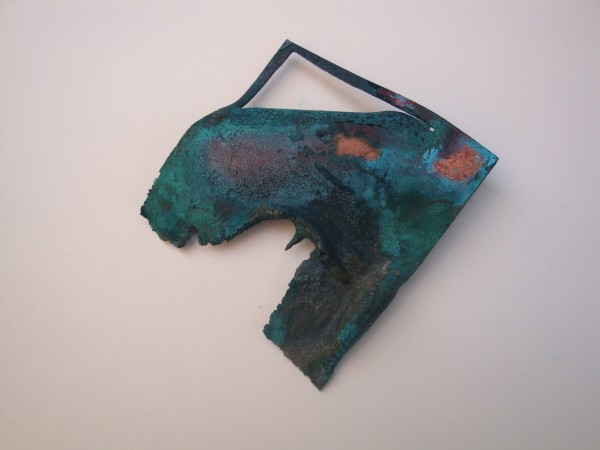
This project has urged me to continue to experiment with the process of evaporation in order to create interesting surfaces.  I have created a few samples, whereby I set up certain conditions that allow a surface to create itself; often with a completely unknown and surprising outcome.  One such experiment allows vinegar to evaporate and then to crystallise on the surface of copper, creating a sand-like texture, not dissimilar to under-fired enamel and with the most amazing colour.


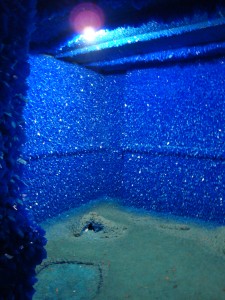
My inspiration for this originally came from a visit to Roger Hiorn’s Seizure, below, in which he coated the interior of a South London flat with blue crystals.  Hiorn flooded the flat with 70,000 litres of hot copper sulphate solution, which was then left to cool and crystallise, creating an atmospheric, striking crystal cave.  I loved the contrast between the tight constraints and rules that he had to follow in order to implement and facilitate the work, and the uncontrolled, unknown natural outcome.


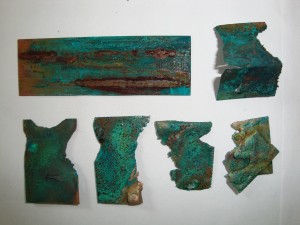
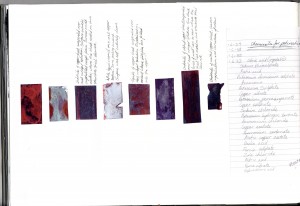
I have previously combined enamel and patina in order to create a similar effect, where the  patina often creeps over the enamelled surface thereby altering the enamel’s appearance. Below are a few samples from my sketchbook.


Here are a few up-close photographs so you can see the surface texture and patina created simply from vinegar fumes.


Kirsty Sumerling

featured in our first Heat Exchange exhibition in 2012.

another brooch

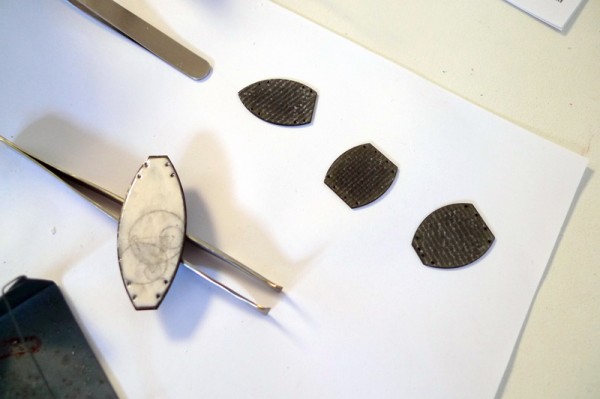
So back here I was waxing lyrical about the parts I was enamelling to put together a bunch of brooches. The image below was taken shortly after the image in that post, and shows the three inserts that I didn’t show before, mid way through enamelling. On the left-hand-side it also shows the centre piece of the work Blue Radical Axis, with the shot taken after applying a clear coat over the graphite, and before adding colour.

The three pieces on the right have each had a clear coat of liquid enamel, and then two layers of linework applied, layer by layer. The lines, first drawn in pen, have been covered in sandblasting grit with the remainder of the grit shaken off, so that just the slim slivers remain, which are then fired on (a technique borrowed from Elizabeth). Now, I say grit, but these are actually Ballotini glass spheres, of a very tiny size, that I would normally use to get a bright (almost polished looking) surface on metal in my sandblaster. They impart more of a texture than a colour, as they fire pretty clear.

Inserts for two brooches. Stainless steel, enamel, graphite, Ballotini spheres

The final layers of enamel on this piece, which happened after this photo, were lines again drawn (3 lines in different directions, to represent x, y and z axes) but this time covered in regular white enamel, so that the topmost layer would have the most effect. Finally, the one representing ‘z’ received a thin coat of red.

xyz brooch. Melissa Cameron, 2012.


Melissa Cameron

Melissa is a jewellery artist from Australia living in Seattle in the US. Her works can be found in the National Gallery of Australia as well as the Cheongju City Collection in South Korea. Her enamel works typically display subtle enamel incursions amidst precise laser cut stainless steel layers.

New Ideas

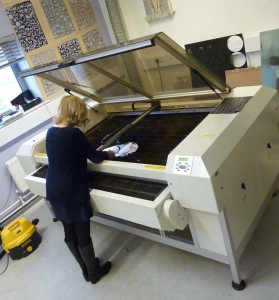
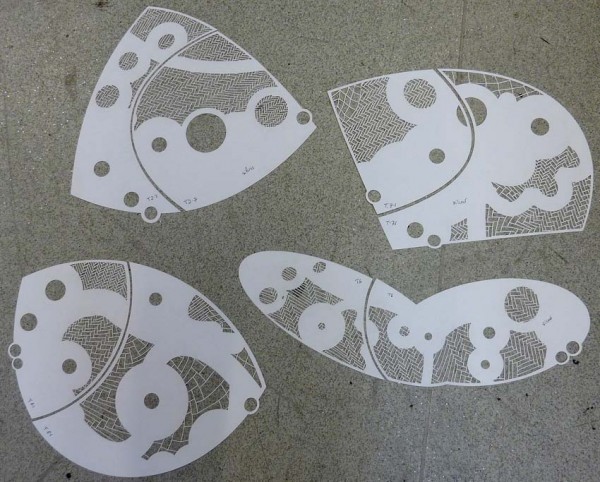
I am so excited too! I am nearly ready to start sampling, which I absolutely love as well. I work in so many ‘layers’ though that it takes a while to get to the kiln. However, I also do enjoy the process of laser and water jet cutting; the experimentation with the medium, embracing the serendipity of the unexpected between technology and the material. All the small multiples are cut and yesterday we finished the silver parts of my ‘companion’ series. The ‘companions’ will have a silver section with small areas of enamel and a white enamel piece with intricate laser engraving. The series of works will be called ‘Streets that run through Houses’ and still revolves around my research into Walter Benjamin’s Arcades Project.


Working on one of the lasers in the faculty.

The paper ‘companion’ tests.


I love laser engraving the enamel and find the so very fine line very beautiful. For me the laser is another medium for drawing, another layer of meaning I can add with the finest detail.


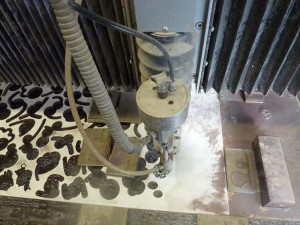
The water jet cutting the multiples


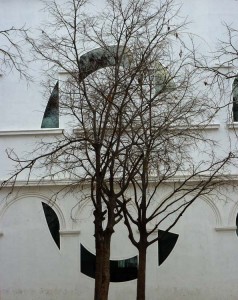
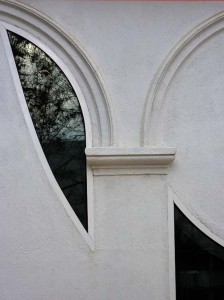
Another exciting event was a short trip to Barcelona last week and I saw some wonderful work. Just walking through the city is inspirational and I wish I had had these images before designing the ‘companions’.


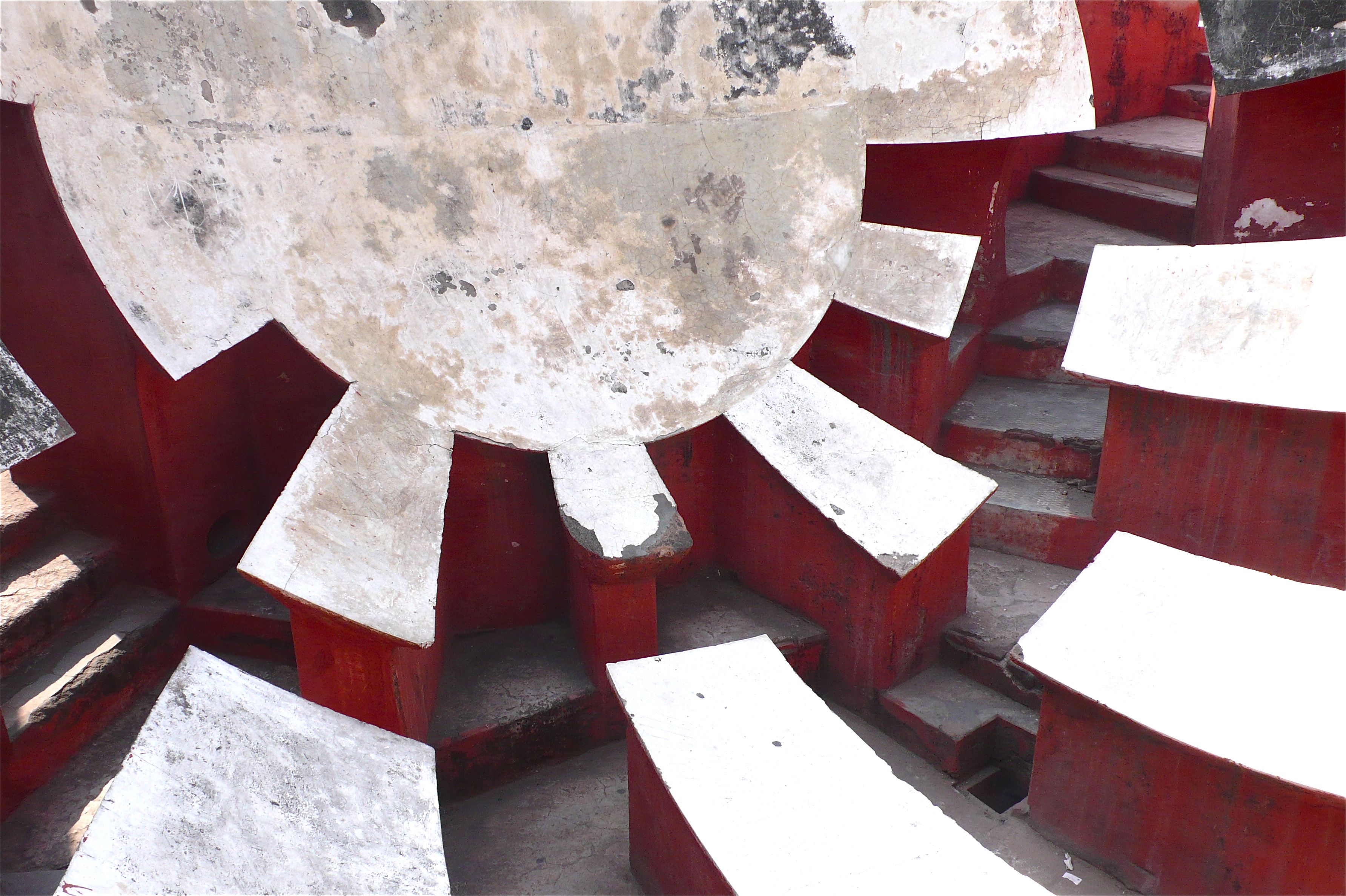
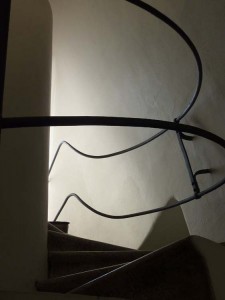
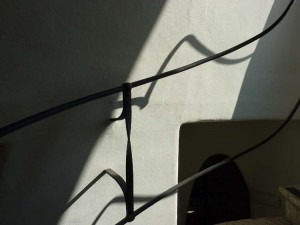
And finally here are a couple of images for Amy: beautiful natural lines in front of a great building.

Beate Gegenwart

Beate Gegenwart is an enamelist and educator originally from Germany who lives and works in Wales, UK. Her studio is located on the beautiful Gower peninsular and she is a Honorary Research Fellow at Swansea School of Art (University of Wales Trinity Saint David). Her large enamel works exhibit an expressive interplay between polished stainless steel and fields of delicately applied and inscribed enamel. She is currently supported by a major production grant from the Arts Council of Wales.

Arthur Hash


My name is Arthur Hash. I work as professional faculty in the Metal program here at the State University of New York at New Paltz. For the last ten years I have been incorporating digital processes (laser engraving, water-jet cutting, 3D printing and CNC milling) into my studio practice.  At an early age I was exposed to computers, mostly video games.  In high school, as part of a technology and design class, I was encouraged to experiment with AutoCAD (a 3D digital drafting program). Years later, I find myself using  CAD software as a sketching tool. I use it everyday, sketching out objects in virtual space.

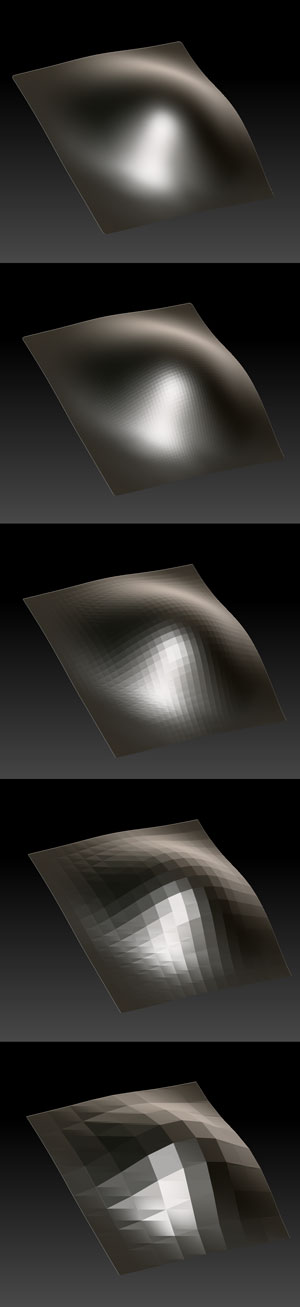
In the world of 3D digital modeling, surfaces are comprised of small polygons or facets. I view these facets as almost a resolution for 3D objects.  It is very similar to digital images. A high resolution digital photo may have 600 ppi or pixel per inch where as a low resolution images might have a lower count. Maybe around 72 ppi. In 3D digital modeling, a HIGH resolution 3D digital surface may have up to 300,000 polygons or more. By increasing the number of polygons the surface becomes smoother and smoother. A lower polygon count produces a faceted object. For example, picture the facets on the surface of a soccer ball. If we double the polygon count then it is more like the divots in a golf ball. Double it again. Now the surface is more like texture of an orange. Once doubled again the surface might be completely smooth not noticeable by the human eye.

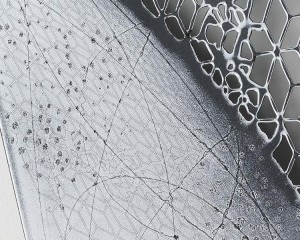
Using a laser engraver I have started a new body of work. I consider these pieces miniature, wearable “drawings”. They are flat projections of 3D digital surfaces. The polygon count has been reduced and the result is an etching that creates a jewel-like faceted surface on the enamel.

The heat of the laser, which burns the enamel at around 2500 degrees Fahrenheit actually “selectively over-fires” the enamel, vaporizing the silica. The result is a black line that is recessed into the enamel leaving a texture. The part of the enamel that is left retains its shine from the original firing.

I have made this short video to show you how the laser works when etching enamel on copper.

For more information please visit my website and blog. I look forward to posting more images and videos.

Arthur Hash

featured in our first Heat Exchange exhibition in 2012.