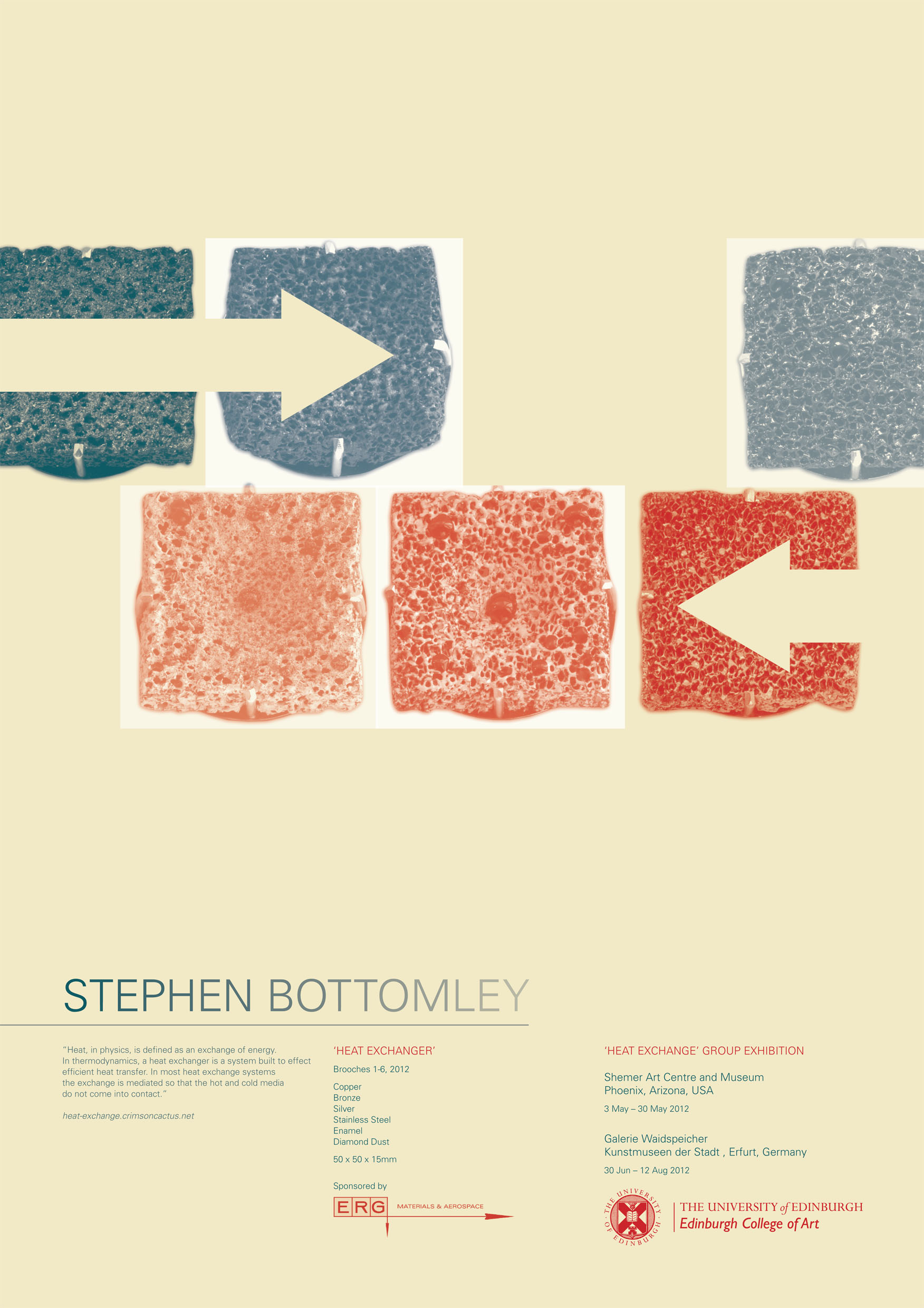

Stephen Bottomley
Stephen Bottomley trained at the Royal College of Art (1999-2001) having also studied at West Surrey College of Art and Design and the University of Brighton, with a key period working within Rhode Island School of Designs’ metal programme (USA 1998). Stephen established his first studio in 1990 in Brighton with a Prince’s Trust Grant, exhibiting his work regularly in exhibitions and at outlets like Electrum Gallery and Dazzle. He started regular associate lecturing work around the South East coast in 1992. After twelve years lecturing and leading several courses at Hasting College of Art, with the University of Brighton, he relocated to Sheffield in 2004. Between 2004-2007 Stephen divides his time between his jewellery studio and his close involvement with both academic life and the jewellery industry, being both course leader for Metalwork and Jewellery at Sheffield Hallam University and also the fourth Chairman of the ‘Association for Contemporary Jewellery’ (ACJ). Between 2007 and afour year project researching the patterns and textiles at the Fortuny Museum, Venice and a solo shows in Venice and back at Hove Museum and Art gallery in 2008, he relocated to Scotland taking the post of Head of Jewellery and Silversmithing at Edinburgh College of Art (eca). In 2011 eca become part of the world class University of Edinburgh. Jewellery is represented by the Crafts Council and held in collections by the British Museum, Royal College of Art and the South East Arts Crafts.
- Web |
- More Posts (8)
A statement about the work…..
We have an ancient art that we practice in modern times.
Vitreous enamel on metal is a ‘fire art’ that stretches back over 4000 years. At its heart is the fusion of glass, metal and ceramic onto metal under heat often in excess of 800 degree Celsius.
The result is simply magical; a hard, glassy, corrosion resistant material that has also combined with the strength of the base metal. Though the form of this base metal can vary for thousands of years it has typically been on thin sheet metal so it can expand and contract at a compatible rate.
In the 21st Century aerospace industry has redeveloped familiar metals with intricate highly uniform structures that allow for the totally even and dependable exchange of heat and energy. This innovation has lead to a modern reinvention of familiar base metals like copper through new material science as super efficient ‘heat exchangers’ for space rockets and aircraft engines. These metals operate under the most challenging environments which have enabled my research into the stable fusion of diamond dust, sprinkled like star dust in the creation space age inspired jewellery.
Stephen Bottomley
Heat Exchanger 25.04.2012