Following a line of thought

In my new Studio

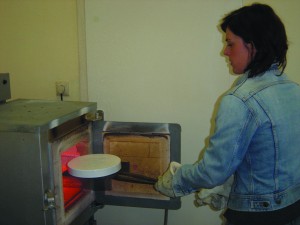
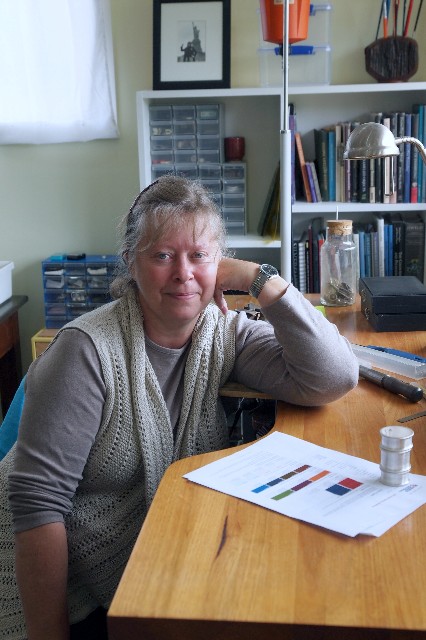
In Australia right now, you would expect some roaring summer temperatures. Not so! We are having the coolest summer ever I think. Fortunately I have been firing so my kiln is warming my studio very nicely.

I would like to tell you a little about an adventure I have been having over the last few years. I have been fortunate to make a delightful connection in Japan through contributing to some International Exhibitions there. In 2007 I received a grant from the Australia Council to go and study Japanese enamelling techniques with a gentleman who has become my mentor and dear friend. Mr Sakurai is now eighty eight years old and has worked for his company, the Ando Cloisonne Company, all his life. So you can see he has a depth and breadth of experience and understanding that is truly impressive.

I have been back to study with him three times since then and on each visit I have concentrated on a particular technique. In my practice, I wanted to be able to work on a larger scale. I completed a post graduate year of studies in 2006 where I worked on larger forms utilising low firing temperatures to create richly textured surfaces. The image below is from a grouping of work based on bushfires. As you know, we have plenty of fierce bushfires in Australia and after one event near my old house, I went out and photographed the ravaged areas over a few months. It is amazing to see the devestated blackened and ashen ground gradually give way to the tiny and delicate green and ruby shoots of new growth.
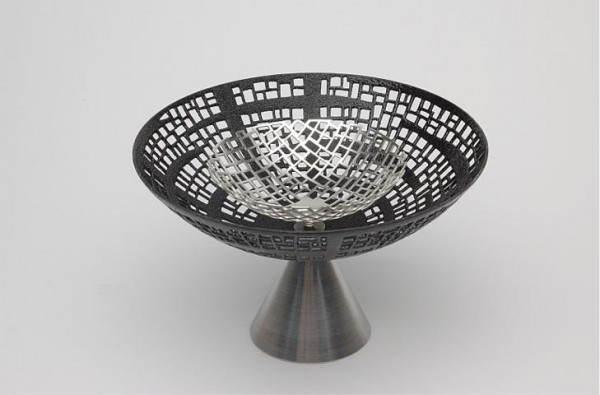
Walking with Fire 2

Now, my Japanese studies have allowed me to return to using cloissone and start exploring it on smaller vessels.

There were two techniques I studied at first; Yusen Shippo and Doro Shippo. Yusen Shippo is really the same as Cloisonne work (shippo being enamel). I have used Cloisonne for years, though now I was learning to apply the wires to a three-dimensional object. This was quite challenging and I learned many interesting tricks. The second technique, Doro Shippo, is actually about the enamel. That is, Doro is a primitive form of enamel that has a rather stone-like quality when fired. It is pretty finely ground, so when mixed with water, it’s quite like working with mud!

I have started working on two brooches using the Doro Shippo. As I have had quite a break from work while re-establishing my studio, it takes some time (and often some dud enamelling) before I get in the zone again. So, start small and work slowly. Don’t make assumptions!
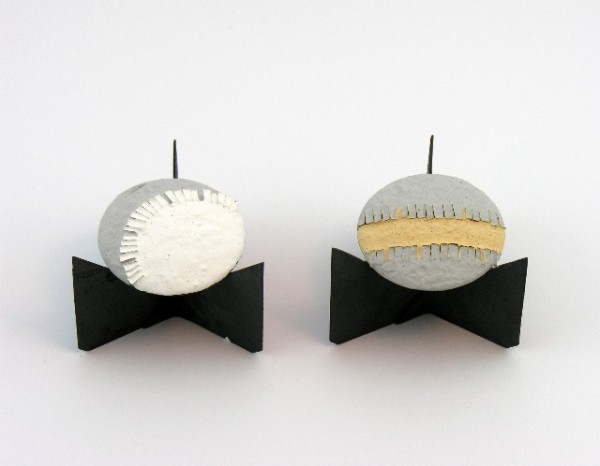
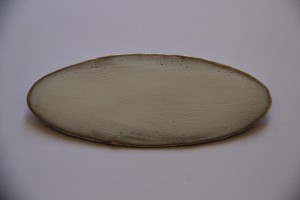
Two Brooches using Doro Shippo; ready for the second firing


Welcome to my world

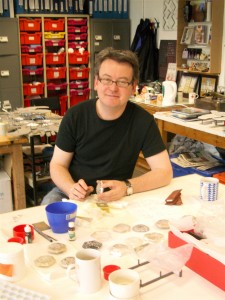
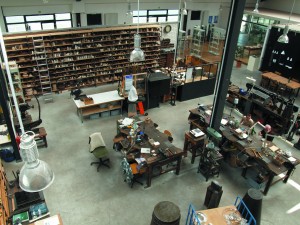
So, I never did introduce you to my studio…

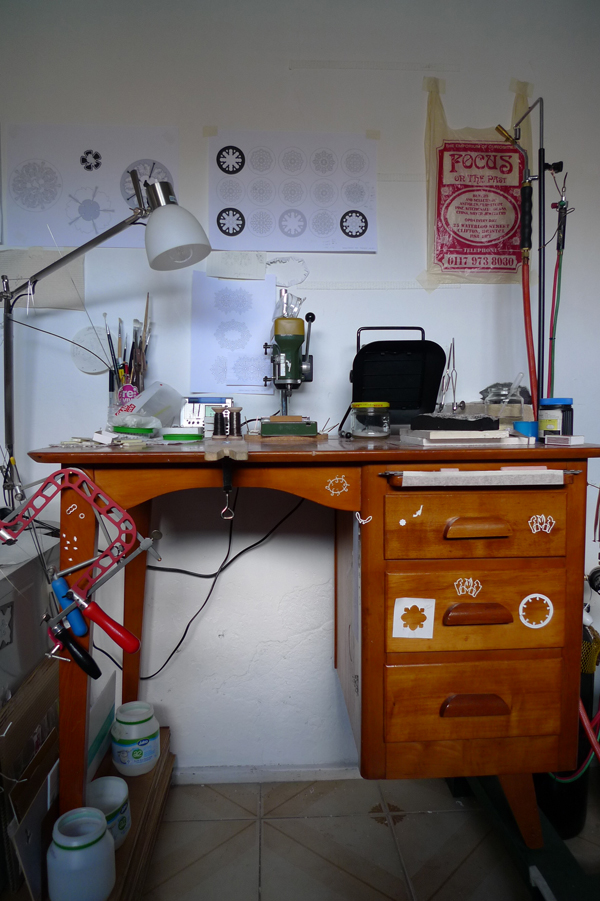
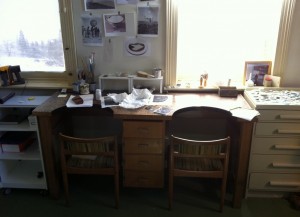
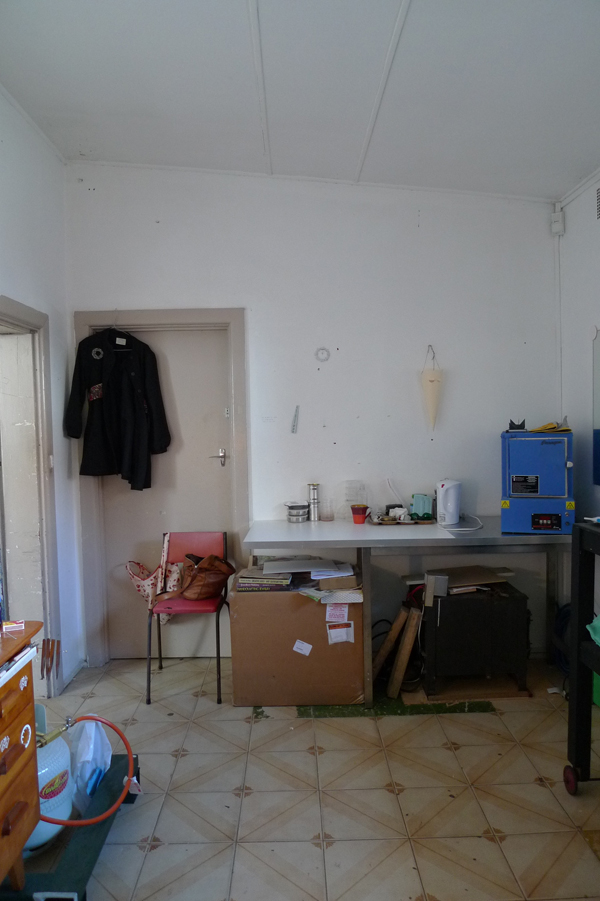
The prep bench and kiln, with an inherited old clunker of a kiln hiding out below (to the right)...
My sorry excuse for a bench, cluttered with tools and pasted with sawn-out, adhesive backed Cad drawings
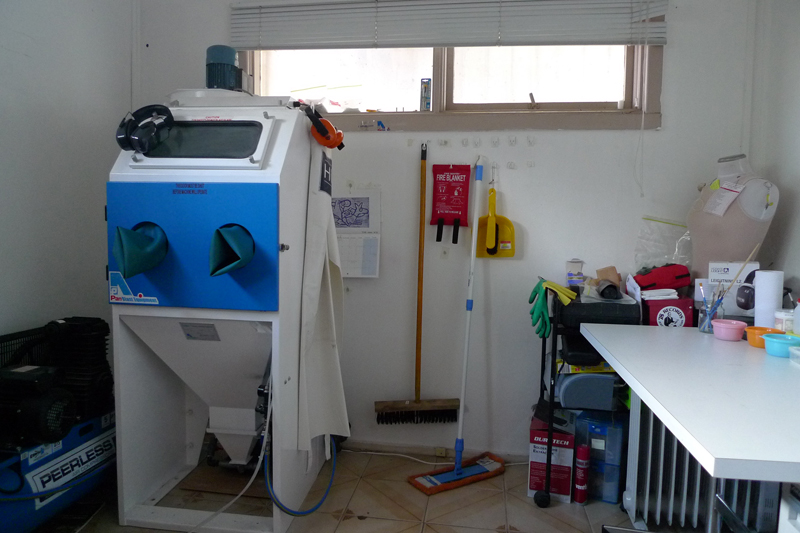
My sandblaster. My 2nd favourite tool, and a great aid for wet-process enamelling on steel. (First favourite is the saw frame - there was only 3 in that last photo, but I think I own 5...)

Traces

Hello,

my name is Agnes and I live in Nürnberg, Germany.

After taking a silversmithing apprenticeship, I frequented for 3 years the Academy of fine arts in Munich, and for 1 year the Academy of fine arts in Nürnberg.

I began to use enamel in Munich around 1998; since then this materiel was never leaving me. When I think about any theme I’m working on, the word “traces” comes into my mind. I’m interested in surfaces, how they change while time passes, how patina develops …

When I’m grinding the enamel-surface, these grinding-traces speak to me.

Late, but not lost!    Agnes


Surface & Substance

Surface & Substance International Contemporary Enamel Jewellery exhibition curated by Jessica Turrell – Ruthin Craft Centre  Denbighshire, Wales. 19 November 2011 – 15 January 2012

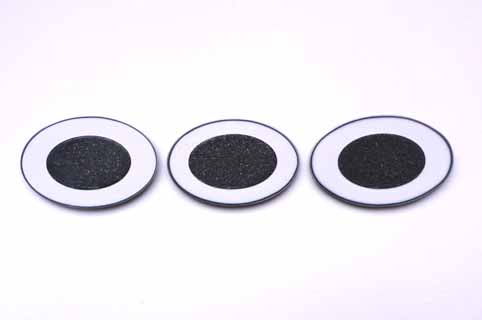
Brooches – Elizabeth Turrell

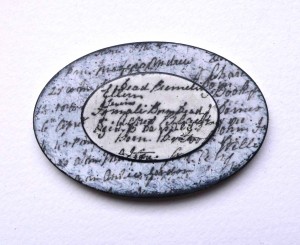
These wearable pieces are forms of an in-memoriam marker, a silent message that may elicit a feeling of melancholia or disquiet. I hope they may encourage conversation. In the pieces that use image and text – there is more than you see – parts are hidden.

Materials and process are a significant part in the thinking and making of this work – that chemical bond of glass on metal. It is the inherent qualities of this material that attracts me at a sensory and aesthetic level.

Using thin white pre-enamelled steel – a functional factory produced material – gives me a bland surface with none of the usual preciousness associated with enamelled jewellery. I am entranced by the different qualities obtainable by piercing and altering the white surface to reveal the qualities of the steel substrate. I like the limitation set by this single material.

These pieces are an attempt to transform and extend the traditional concept of vitreous enamel on metal: the glassy, the decorative, and the perfect surface. This material seemed best suited to express and clarify my intentions.


A lot of drawing

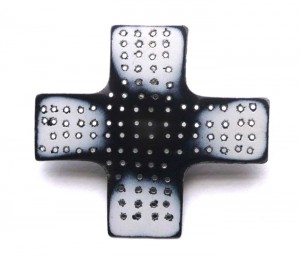
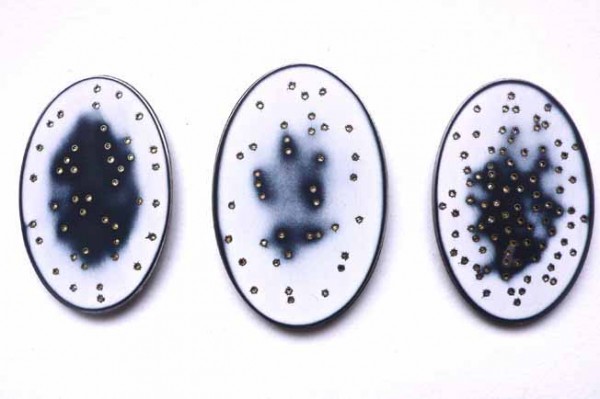
Just like you, Melissa, I have been fascinated by the black ‘halo’ surrounding liquid enamel on steel and many pieces have been built around it, polishing the surrounding steel back to a silver surface. It is so very frustrating though that sometimes the ‘halo’ is beautiful and jet black, at other times thin and frayed. My theory is that it depends on the particular batch of steel, the iron content, how it is rolled etc. (And of course, how I feel when I work and apply the enamel)

The below is an example of a piece from ‘Playing with Fire’, perfect edge.


I have never been able to achieve the same, although I am trying to embrace the serendipity of the kiln and the material. The results for Drawing, Permanence and Place were rather different.

And a close-up:

Any advice would be great.


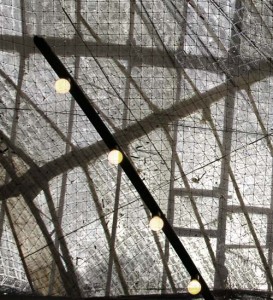
I have begun drawing, drawing, drawing. First on paper, then in Illustrator. I have been looking through my photographs from the arcades in Paris, still loving the strange netting on the roofs and curved ceiling lights.


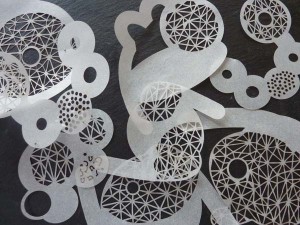
I am ‘circling’ around many ideas; at the moment I am thinking of an installation of many multiples. I will write more about the concepts underlying the work in a future blog, for now I would like to give a brief visual flavour of what i am thinking.

Here are my first experiments, in paper:


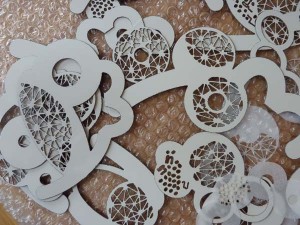
and water jet cut in pre-enamelled steel. They will change quality once they are ‘properly’ enamelled.


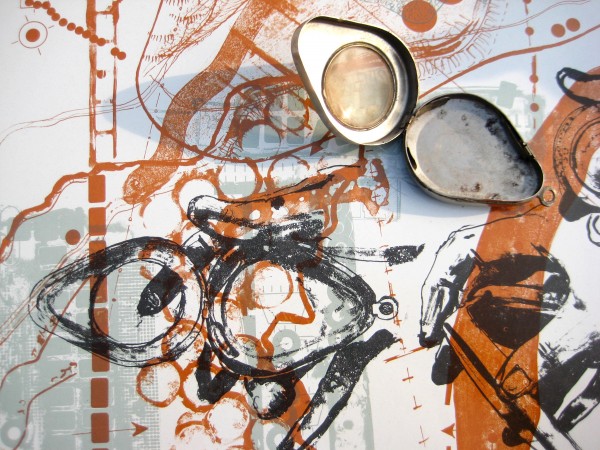
Drawing a brooch

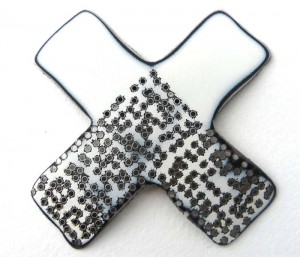
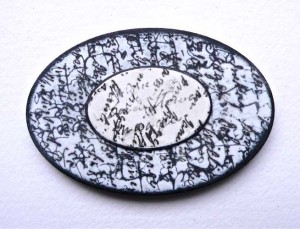
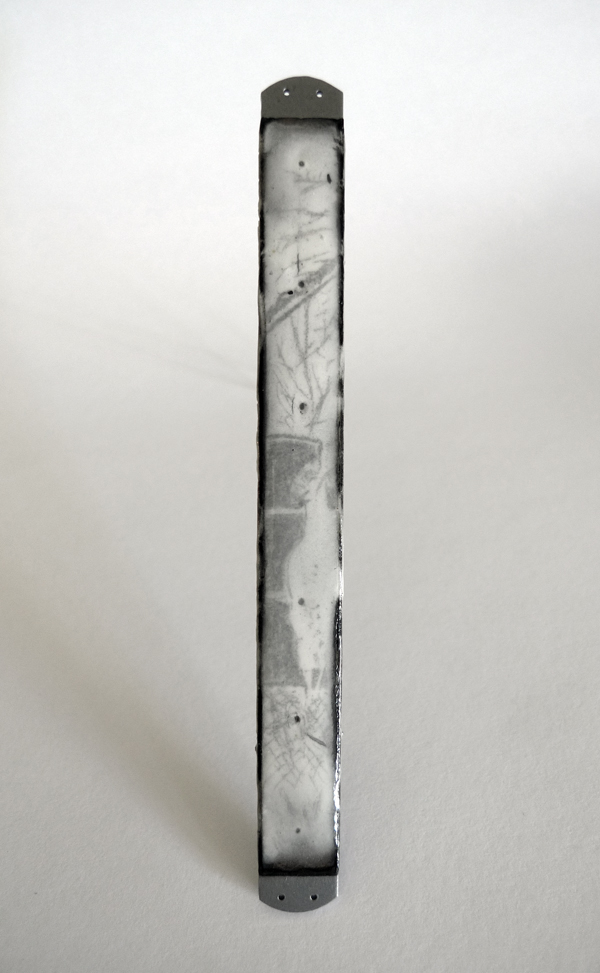
My enamelled test piece, Slivered Coaster. Melissa Cameron, 2011. Mild steel, graphite, vitreous enamel, 925 silver fixings

This is an enamelled piece that I made as a response to a recent work, and as a test piece for my works for the Heat Exchange project. Thus it has some faults, but has also proven to be quite instructive in determining what I’m after, especially in terms of the shape of metal substrate I’m seeking to use for my current works-in-progress.

I’m going to analyse it, for my own reference, (something I guess I would normally do, but not ‘out loud’ like this), starting with the faults, as I see them.

– The edges need better finishing – I’ve ordered some diamond abrasive pads and would ideally smooth the edges to be consistent. I actually like the black frame line too – but I think I have to work at making it a little more consistent also.

– The line of dark dots down the centre – these were intentional as they mark holes in the metal that the enamel has covered, and were kept to match the work that this piece was responding to. They seem out of place in this work however, so I would not be working to cultivate them if I made this piece again. (Having re-read this, and looking again at the image, I’m now wondering about my Descartes connection, and what I have drawn so far. In some instances maybe they will stay…)

– The clarity of the drawn image – It’s not clear what it is, and I think this results from the choice of image combined with its use in such a tight area.

The things that I like about this work

– The shape and its potential omni-directionality

– The graphite drawing – there is something very beautiful about the overall materiality. Several people have mistaken it for mother-of-pearl, which is interesting. I made another brooch on the same day, but the markings in graphite are less interesting/evocative.

– The combination of sandblasted metal + enamel – Shiny versus matte. Contrast is good.

That’s a lot of feedback, from one small piece, 105mm x 10mm.

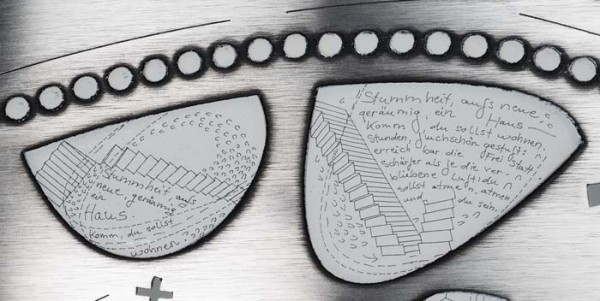
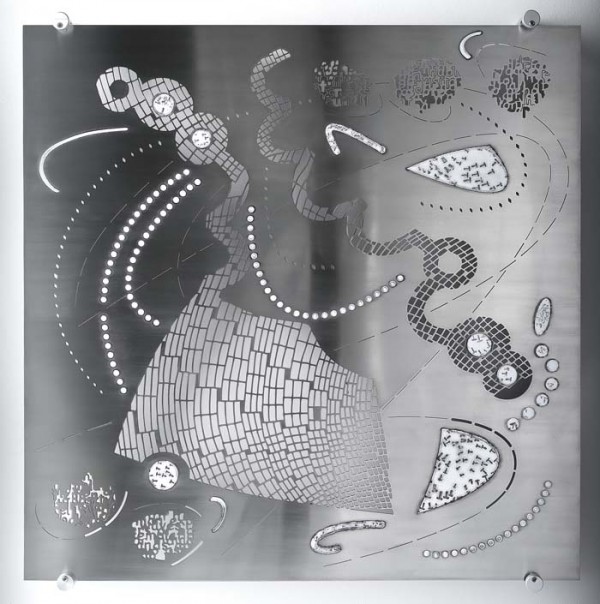
I’m in the process of drawing patterns, that I will have laser-cut in stainless steel. This is the first time I’ve made these drawings with enamel in mind. It’s a long process, so it still feels like I’m a long way from doing any enamelling.


a place to think

It is wonderful to be in touch with you all as we work toward this exhibition.

I am Kirsten Haydon and I have been working with enamel since 1997. I have always found myself to be intrigued by its mysterious and magic qualities, the expected and the unexpected.

Debbie Sheezel, a wonderful enamellist who taught herself the process of enamelling over forty years ago, first introduced me to enamel at RMIT University. Debbie shared her passion, enthusiasm and knowledge of the material and inspired many students to explore its potential.

I now teach enamelling at RMIT University and I have been lecturing there since 2002. I find that I discover more as the students succeed with their visions.

My own research is in the area of Antarctic landscapes and when I am not teaching or with my family I find myself thinking and remembering my experiences of this landscape.

the new recruit..

Hello fellow exchangers,

Fashionably late to the party, but great to be here!

Enamelling in Bristol, 2006

My name is Stephen Bottomley and I live and work in Scotland. I teach at Edinburgh College of Art www.eca.ac.uk in the Jewellery and Silversmithing department and enamelling is an important part of my practice.


First introduced to enamel back in 1988 at Farnham College by Jane Short, I was immediately fascinated by the material and process and have increasingly integrated it into my work over the past two decades. I began to approach enamel with less ‘awe’ and more ‘bravery’ through teaching it at art school a few years later. Teaching is always a two-way experience and my enamel came to be influenced by many of the highly skilled ceramicists I worked with on the multi-disciplinary course in Hastings I worked at for 13 years.

Time spent working in Bristol with Elizabeth and artists visiting her and Jessica between 2006-10 was an incredibly valuable time. Sharing god practice and ideas was so very important then, so I suppose this is a chance to try it in a different media on line now.

A couple of moves up the UK since then I am now living happily in Edinburgh and enjoying the challenge of a busy department, the inspiring company of inquisitive students and the company of fellow makers (like Elizabeth and Jessica Turrel and last year Mellissa) who visit us and share their skill and knowledge so generously. Together we all work and play and along the way build a culture to contribute to contemporary enamel and this very special art form.


Last week I travelled to Ruthin, in Wales to see the ‘Surface and Substance’  exhibition devised and organised by Jessica Turrell. It is a real gem of a show! I’ll post some images and text next.

I am really looking forward to being part of the Heat Exchange and have already learnt interesting things from the blogs I have read so far and about your special interests.

Flame on!

Hi from Bremen, Germany

Hi, my name is Astrid. I work and live in Bremen, Germany. I have studied jewellery design at the Hochschule für Gestaltung Pforzheim’. I graduated 2003. Since then I am working on my own. I am doing a lot of jewellery without the enamel.Yet, I am very excited about the project, because it challanges me to try some new work in enamel which I had in my mind for some time.

an exploratory approach to enamel on iron…

hello fellow heat exchangers,

my name is Cath and I recently completed an MA at UWE where I met Elizabeth Turrell. Her enthusiasm for enamel led me to experiment on steel as a drawing substrate and consequently I became fascinated in applying enamel to found objects.

I am currently researching coal-industries within Wales, exploring a means of translating and recoding history to relate a duality between terrible working conditions in a coal-pit with the solidarity of social communities. I am motivated by a sense of mortality positioned in the moment, the power of ordinary objects to convey a sense of humanity, and notions of morality within shifting, ideological perspectives.

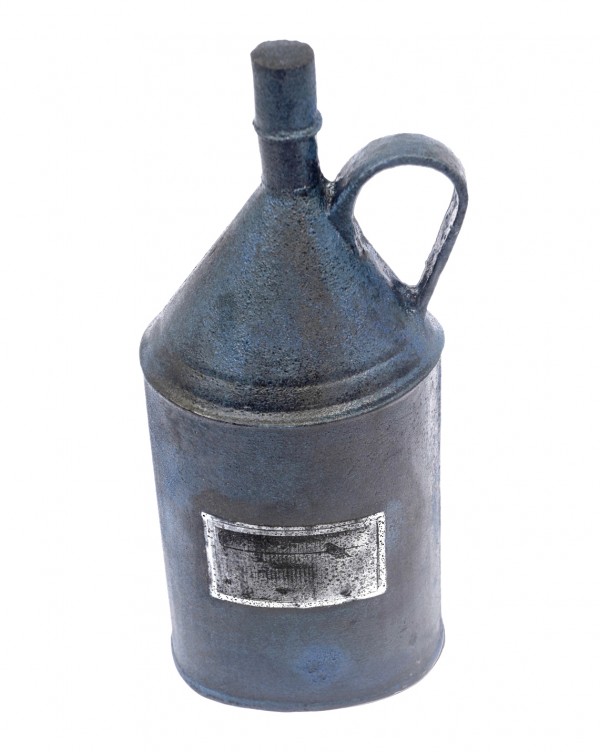
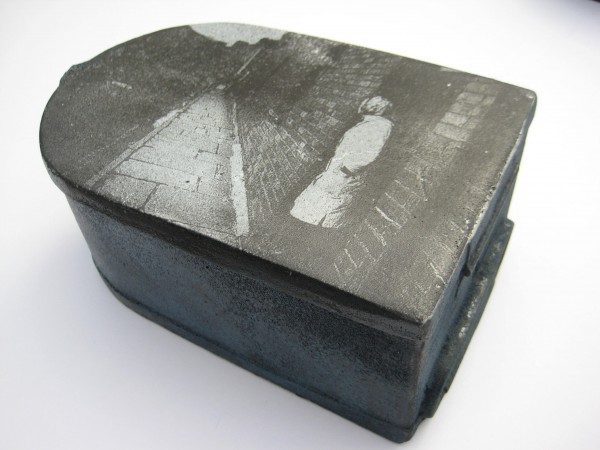
In making cast-iron replicas of utilitarian mining-artefacts I hope to simultaneously create an illusion of authenticity with sculptural solidity – like a paperweight, to hold firm or make resilient a snap-shot of history. Through a remnant object I want to capture the implication  of what was there seen through what remains. The heavy material acts as a metaphor for weight of subject matter, giving the impression of permanence to a forgotten industry.

Through my experimentation with enamel I have had some partial success using decals to apply documentary photographs to the 3d cast objects. But I have also discovered infinite technical problems resulting from the porous nature of iron and defects in the material I have access to: my inability to solve these problems has resulted in an interest to take advantage of them: I hope to use this Heat Exchange opportunity to develop a more exploratory approach to enamel on iron, to embrace the learning possibilities of a dialogue exchange.

I am so excited to participate and very nervous about my limited time. This opportunity is particularly significant to me because it holds my focus on enamel processes and demonstrates my need to create a new studio environment. I look forward to hearing how everyone’s response to Heat Exchange unfolds…

artists exchanging energy