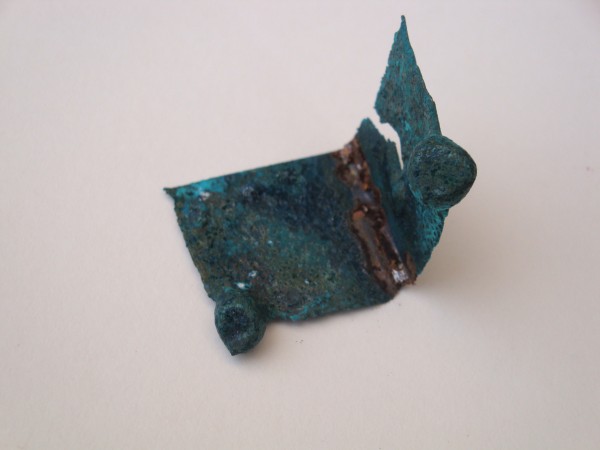
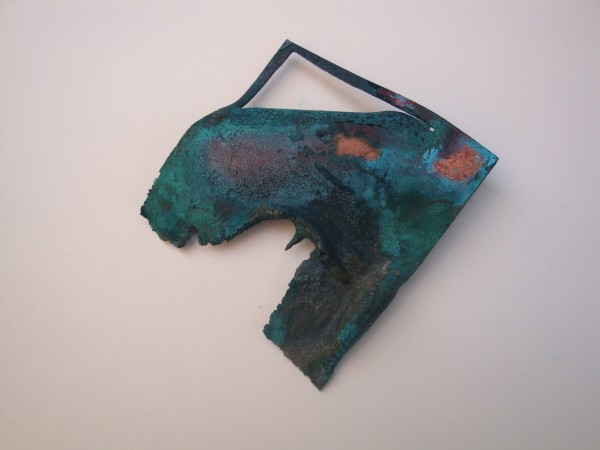
The work is almost done…I will post more info when complete…
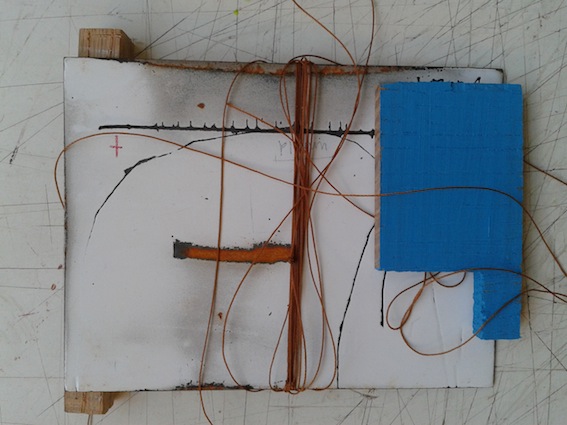
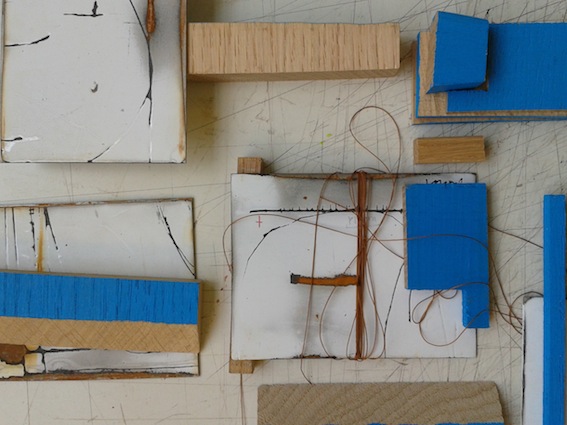
The work is almost done…I will post more info when complete…
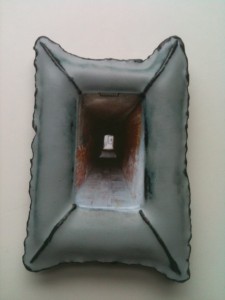 I am finally starting to finish this work! I apologize for the poor quality photos. There is no time to stop and fuss. In the next entry, I will post the last pieces and sort out some of my thinking about this new work.
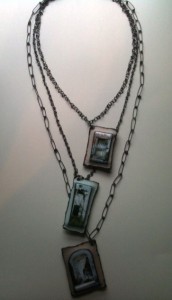
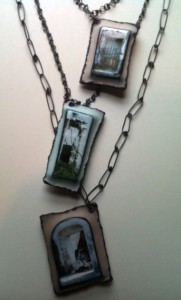
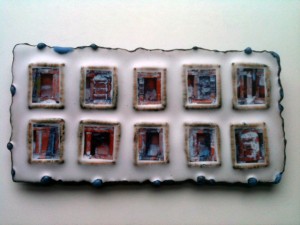
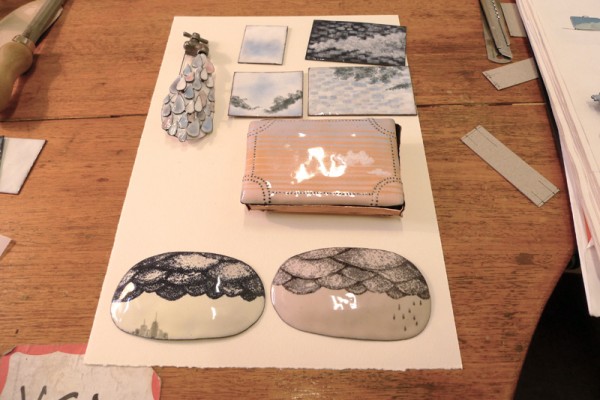
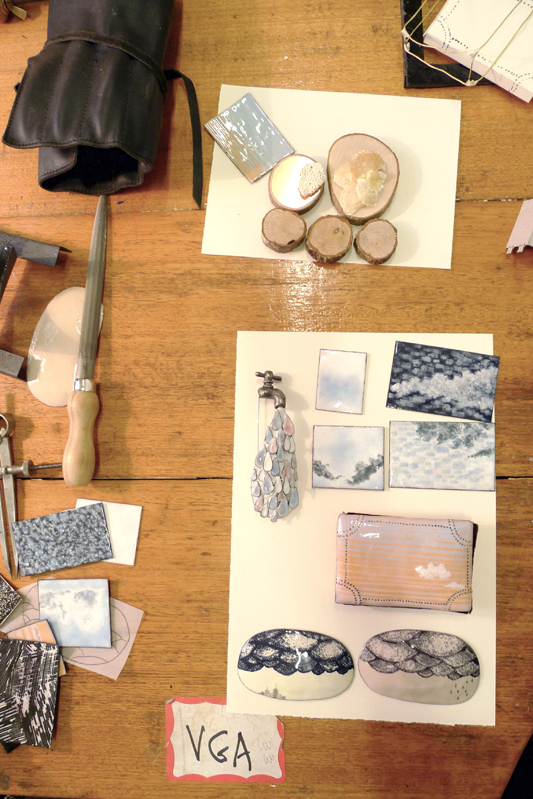
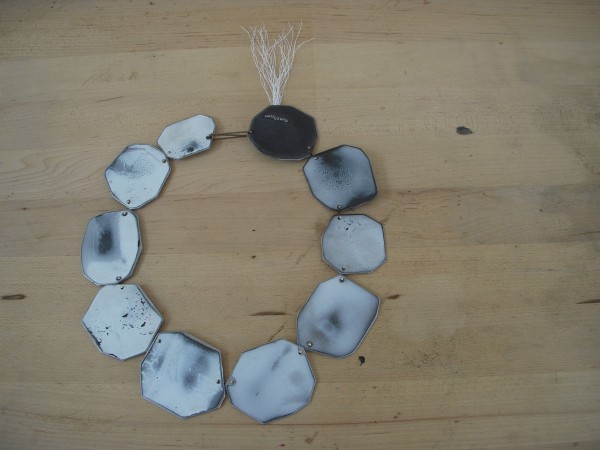 I have completed a few pieces…I’m pretty sure these will be accompanied by found objects to tell a story about age and small, quiet moments…Things have changed since the last time I posted, but, honestly, I knew they would.
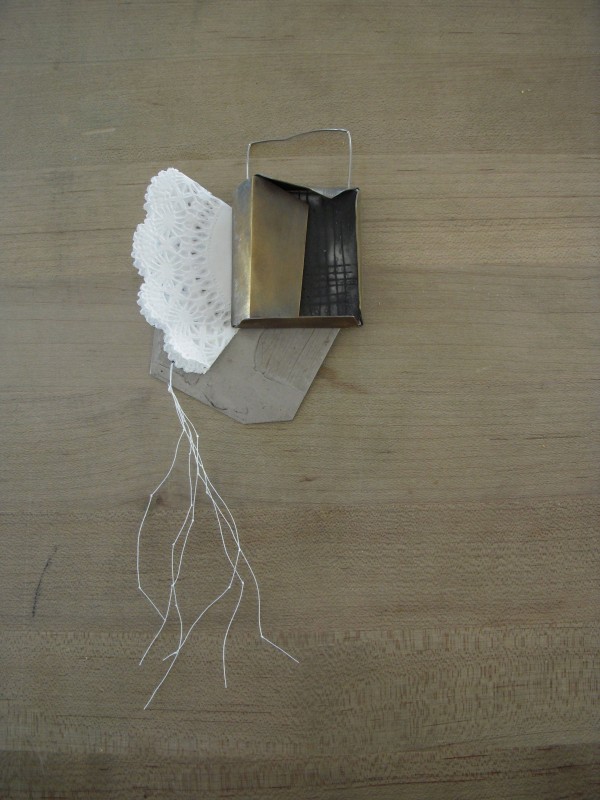
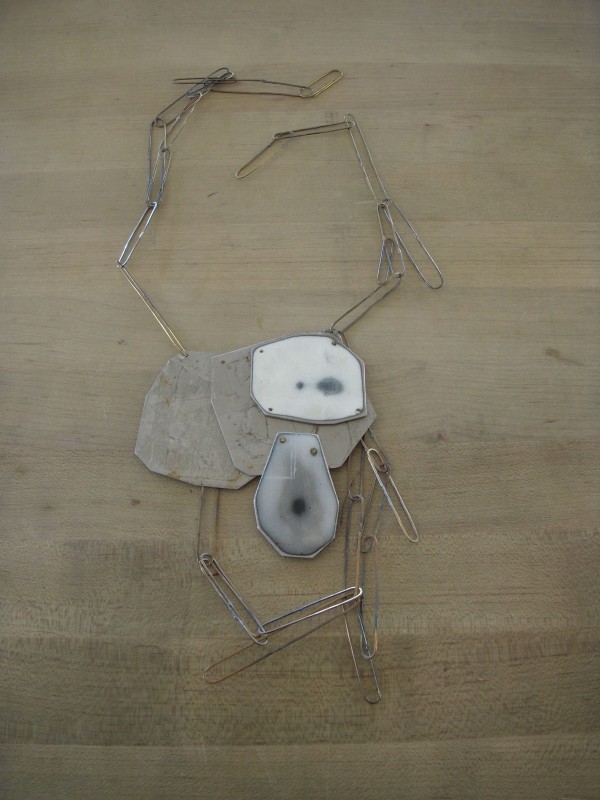
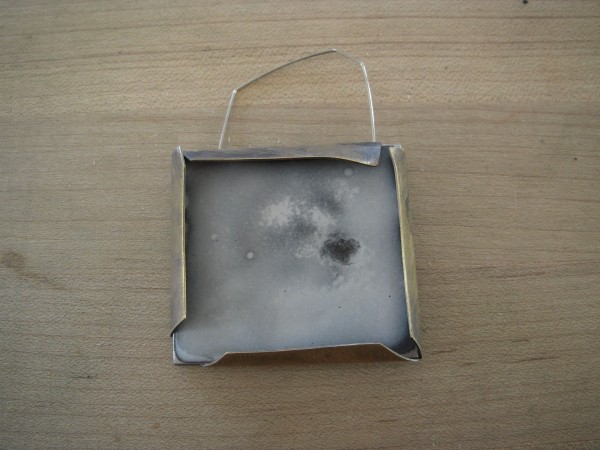 More images on Flickr.
Thanks so much for reading.
In response to Melissa’s comment about embedding the finding for an enameled piece, I thought I would add a few images as to how I do this for welding, then enameling. I am trying something new and this is how I do it.
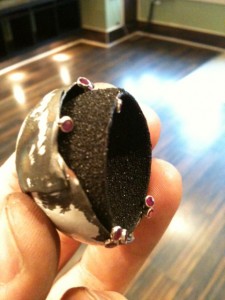
First, of course, I fabricate the pin back finding. For a vertical piece I use a “barrette” style pin back. After I make the findings, I hard or IT solder wires into tiny holes that I have drilled into the back of the findings. In some cases, I use pins that go through form front to back to avoid soldering that could melt during enameling process. I then feed the wires through matching holes that I have drilled into the back of the brooch before welding. Before I do that, I chase a seat for the finding so that there is a place for it to rest and a place for the enamel to pool around the finding.
I then turn over the piece so that the wires are exposed and with a mini torch, I ball up the wires until they lay flush with the interior surface. I then weld the two halves together and enamel. The most difficult part of this is to weld the copper without melting the silver findings as the melt temperatures between silver and copper are so different.
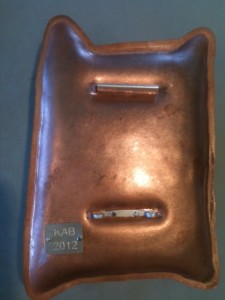

balled up wires on the interior before welding

exterior with findings before welding
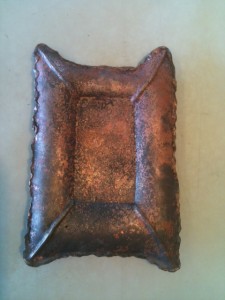
front of brooch after welding
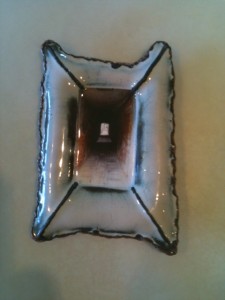
front of brooch after enameling and before etching
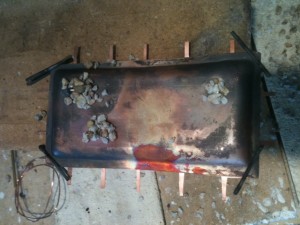
brooch, before welding-how to protect findings
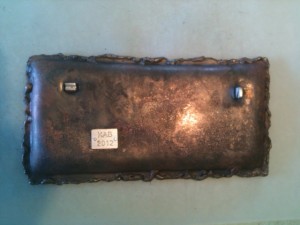
findings after welding
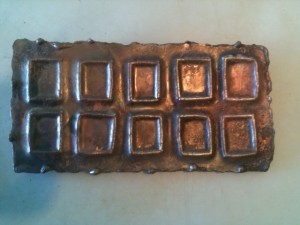
front of brooch after welding
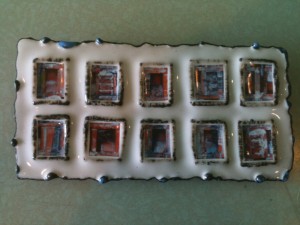
front of brooch after enaneling and before etchingback of brooch with findings-before clean-up and etching
This is my first post to the Heat Exchange blog. I’m excited to be part of this group and welcome comments to my post.
My name is Susie Ganch. I am an artist currently living in Richmond, VA where I am associate professor and head of the Metal Program at Virginia Commonwealth University.
My studio practice has been divided between collaborative community projects, namely Radical Jewelry Makeover, and my individual studio work that explores jewelry and sculpture. Currently, I’ve been working on 2 paths (in the studio): a series of work using non-recyclable plastics that comments on our habits of consumption,


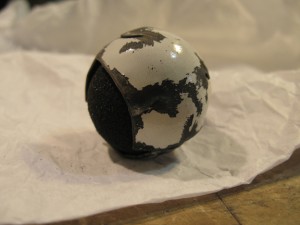
the other a more refined series of enameled brooches, titled Soot Balls, that explore our responsibility and desire.
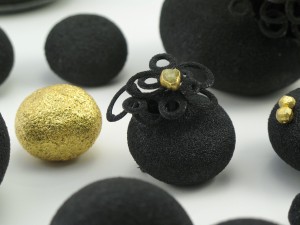 For the Heat Exchange exhibition I plan to combine some new ideas/pieces with the Soot Balls into a grouping of work.
3 things came together for this new current work that I’m making for Heat Exchange:
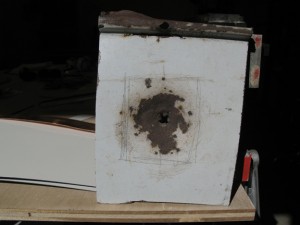
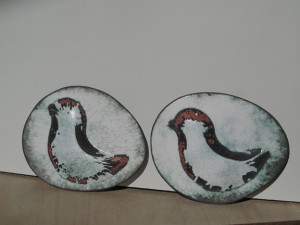
A number of years ago while teaching at Penland School of Crafts I began experimenting with die forming plates that were already enameled. Some of them were enameled plates from the scrap yard, such as dryer doors, or copper plates that I enameled myself. This started because I collected a piece of dryer door that someone had shot with a bullet. The hole, the rust, the stress fractures, were all beautiful and enhanced the surface of the enamel in such a way that I could never achieve through the pristine methods of sifting and baking enamel in the traditional ways I’d learned. My first tests were of bird dies. The cracks happened along logical lines mimicking the contours of the form. I was excited about them but work didn’t come out from this experimentation until now. Below are pictures of the shot dryer door and my samples:
Another thing that lead me to this current direction was a gift I received (also a number of years ago) from Christina Miller and Helen Carnac, two jewelry artists who work with enamel. They sent me pre-enameled steel plates with the challenge to “do something” with them. My samples in forming enameled plates seemed like the logical direction.
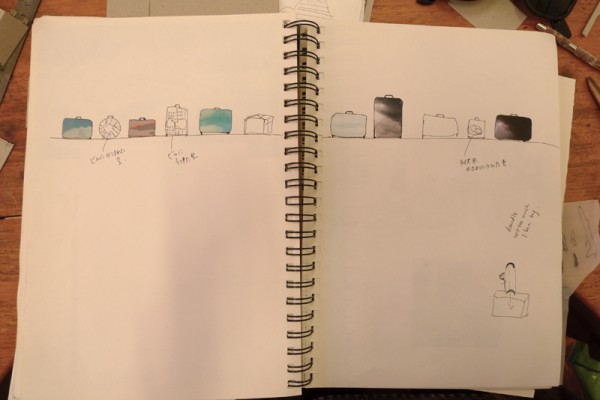
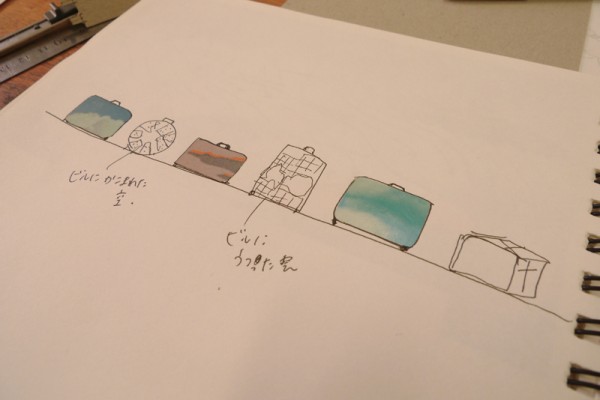
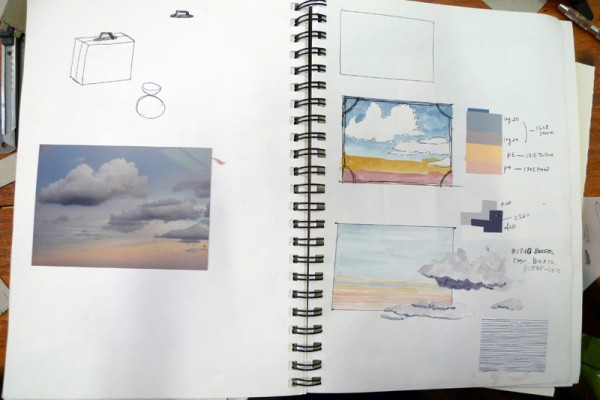
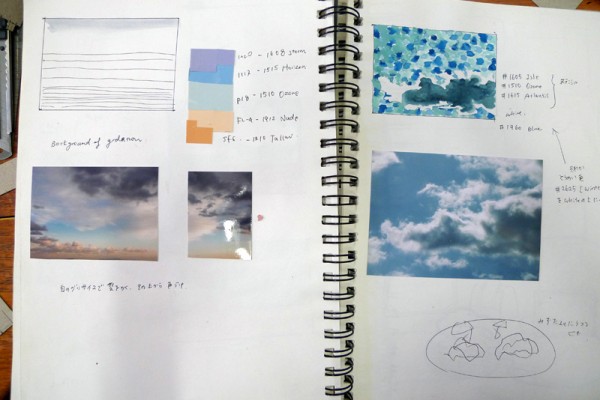
I’ve been filling my sketchbook with drawings and ideas for how this work might come about…
Recently I visited my friend’s studio to learn steel fabrication and welding techniques for some larger pieces that I’d like to explore. Hoss Haley had just finished working on some pieces using the sheet steel skins of washing machines and dryers, compressing them into spheres and stacking them into a random towering sculpture. Of course it instantly captured my attention for its use of materials and form, two things I have been thinking about (the pre-enameled plate) or using (spheres) in my own work for a while! When I returned to my own studio the first thing I did was create a version of his large sphere as a brooch. As an artist who makes both jewelry and sculpture, I have for a long time explored the differences and similarities between the two.
In making this brooch I was really struck by what I saw and thought. There is such an obvious similarity between my tiny brooch and Hoss’ sculpture and the conversation between the two compels me. One moves through space and time, one can’t. Both are privately and publicly experienced but in different ways. While I am having a private experience wearing a piece of jewelry, there is an obvious publicly shared view of how I look, feel, and represent myself to the world around me. When viewing a piece of sculpture, (Hoss’ is at the Asheville Art Museum in Asheville, NC), I have a private moment in a public space. When talking about audience, I also wonder which one will have more viewers: the one that moves through time and space, or the one that remains in one place? Both activate space: one on the body, one interacts with architecture. I won’t continue on this trajectory but suffice it to say, I began to explore the possibilities of this comparison combined with other perimeters (for making jewelry).
I’m on my way….
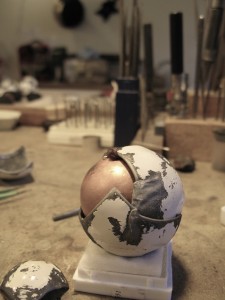
Here are some images of in progress work. I’m combining the distressed enameled plates with sugarcoated enamel, rubies and diamonds.

I am Kathleen Browne, head of Jewelry/Metals/Enameling at Kent State University in Kent, OH and am excited about participating in Heat Exchange and am ready to jump into this with some images of my progress.
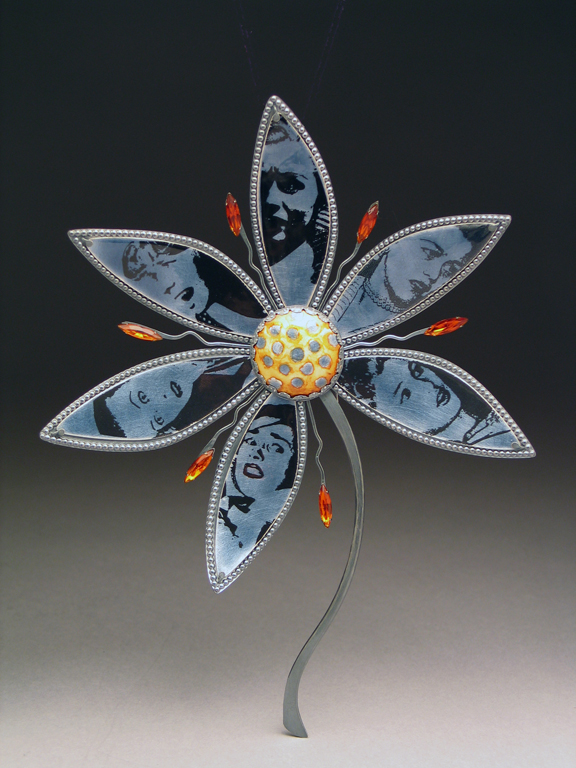
I have been working with hand-screened enamel decals for about 12 years (a process I learned at the Centre for Fine Print Research at UWE in Bristol-Thanks, Elizabeth!). Photography has been at the center of my practice for many years and decals made from my own photographs or from appropriated photos seemed to just make sense.
Below are a couple of images form the “Daily Confidential” series.
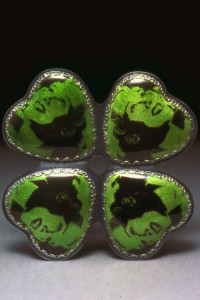
After completing the “Rhinestone” series ( 2 images below) in 2010, I decided to take a break and work on some new ideas-break away from the jewelry conventions I always used in my work.
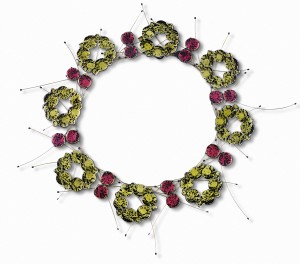
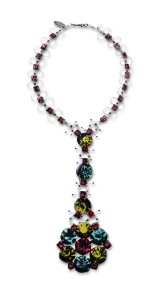
I had been teaching students how to weld copper for years –every since we had Deb Lozier in for a workshop- but I had never really done anything with the process for my own work.
I took the opportunity while participating in last fall’s exhibition, “Surface and Substance” (curated by Jessica Turrell) to produce some work that marked a turn in my practice.
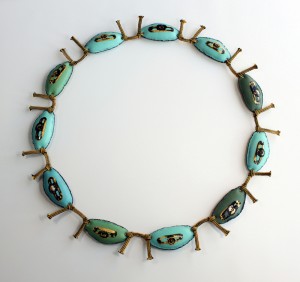
This small body of work titled, Treasure, was a response to a beautiful collection of 19th and early 20th century jewelry that was discovered after the passing of one of the members of my family. As I researched the jewelry and its history, I uncover filial relationships and family milestones that were marked by the giving of jewelry. I photographed a number of these jewels and converted them to enamel decals. These “jewel” images sit of the surfaces of organic “fleshy” forms, I have created, like a mark or tattoo on the body in the same way that family history marks and shapes who we are.
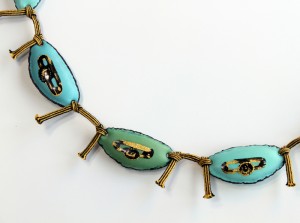
I
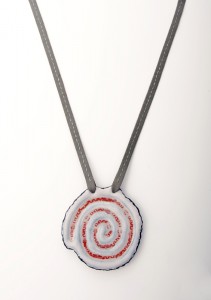
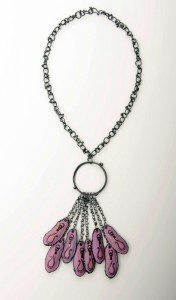
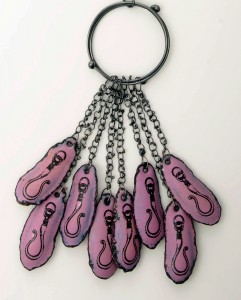
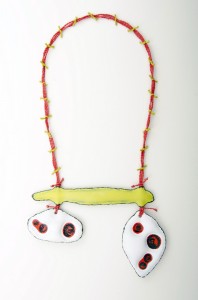
I see this work as transitional and the work that I am making for Heat Exchange marks a new approach to the photo for me.
For “Heat Exchange” I have had commercial decals made from some of my photographs. This provides a very detailed and colorful image. I am struggling a bit with their “exactness” and detail but the challenge is very invigorating.
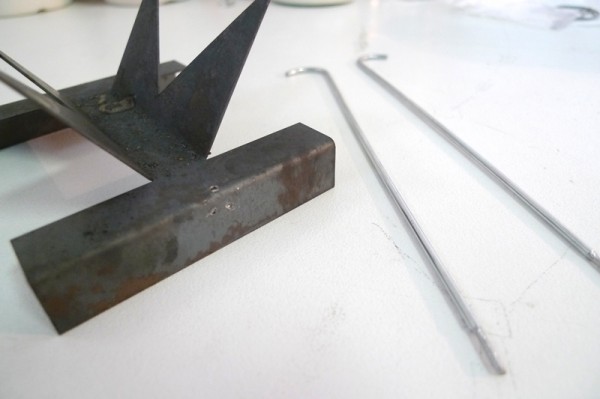
Here are some preliminary images of the works in progress. I will start welding this week. One of the hardest bits of problem solving has been how to build the pin finding structures into the pieces before I weld them!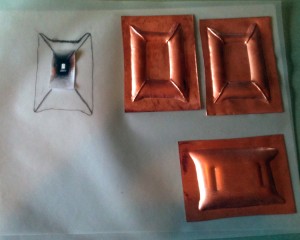
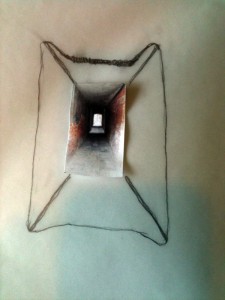
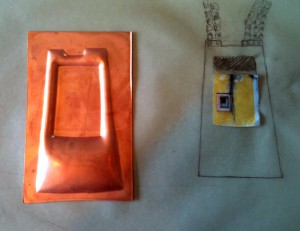
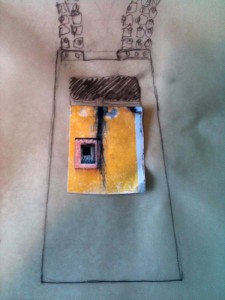
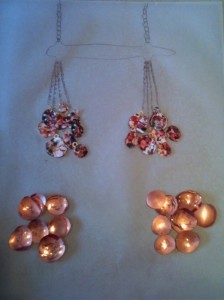
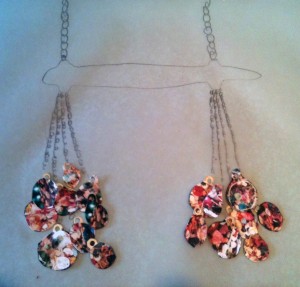
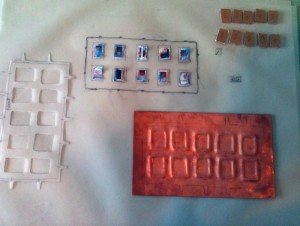
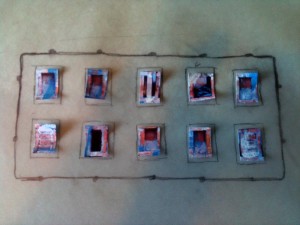
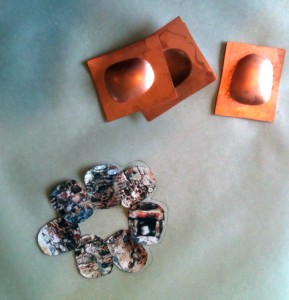
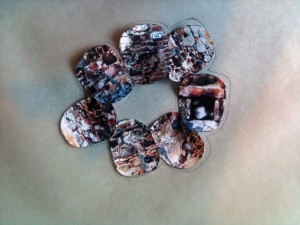
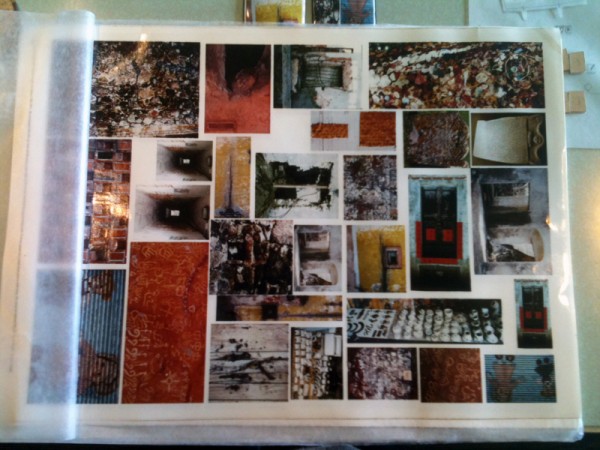
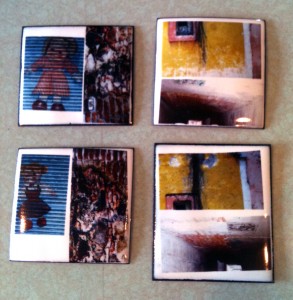
Arise my monster!
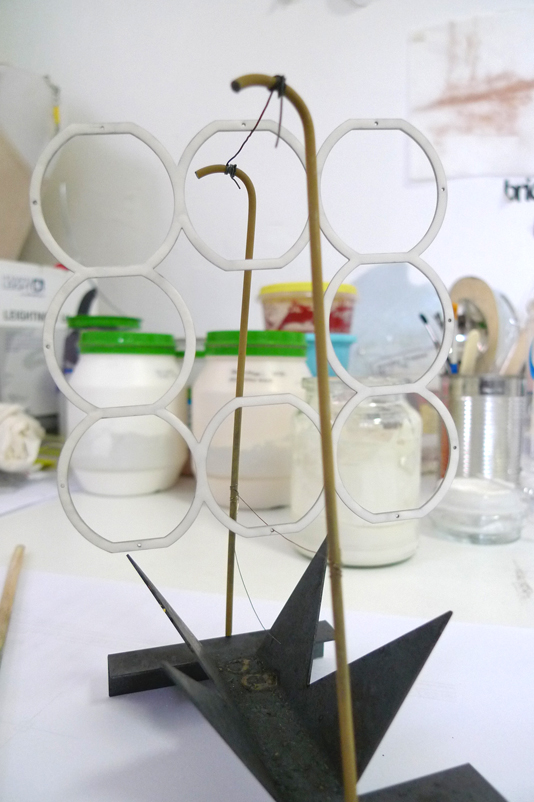
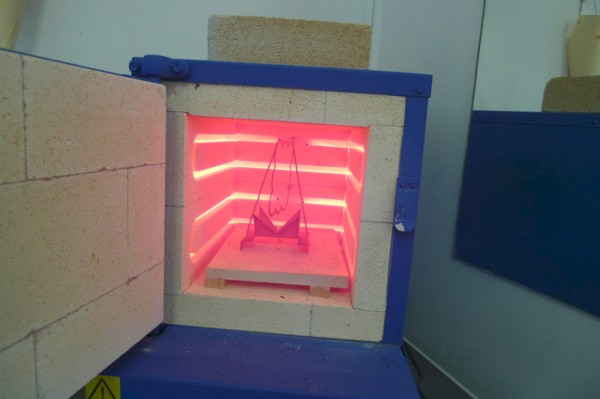
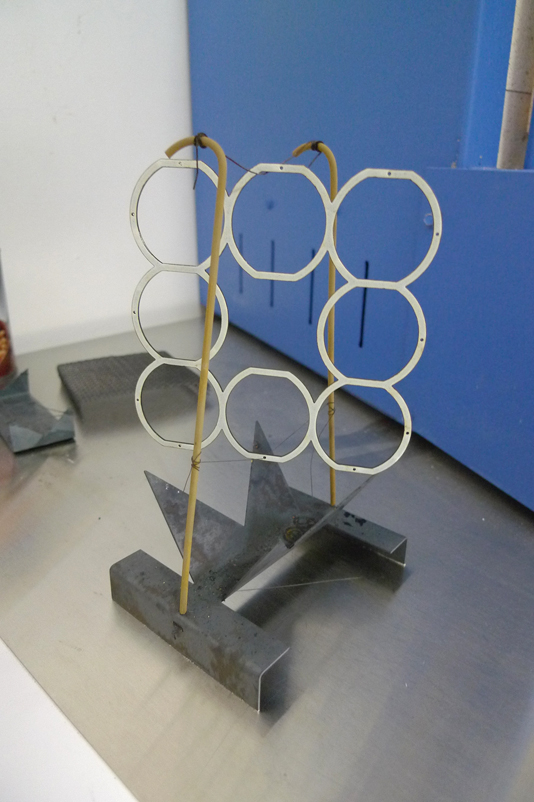
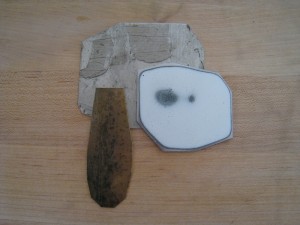 I had to take a short break from enameling to devote time to other things including planning classes and my upcoming European trip and also to teach a chain-making class. Once I returned to my assortment of samples I felt like it might be time to start considering how the pieces could work together, what steps I needed to take to move forward, whether or not I needed more samples, and so on. ( I start teaching a two-month class in less than two weeks here at Penland and I know my time will be extremely limited then. It really is time to shift from making components to making pieces.)
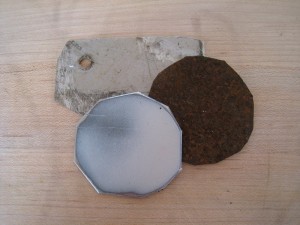 I am imagining collages or compositions of several elements: an enameled shape, some found steel, a rusty piece, a copper or brass hollow form. These pieces will be held together with rivets, bezel or tab settings, and/or some stitching perhaps. I work well with lots of elements in front of me. I enjoy the process of moving things around 3-dimensionally until a composition feels right, balanced, interesting, complete…I imagine the work as a series with similar but slightly different components. The images I have posted today are a group of sketches. I’m looking forward to seeing how things change once I begin constructing the pieces. Oh! And they will be large brooches!
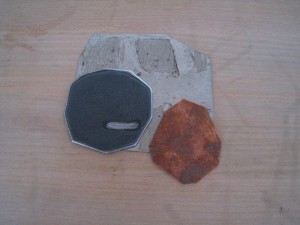
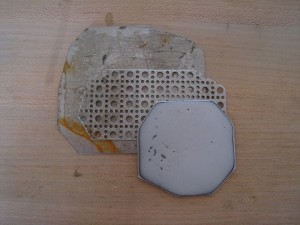
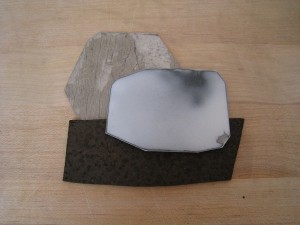 The enameling is fairly simple as you can see. It’s mostly atmospheric, but I do like the stark quality each has and what they do for these initial compositions.
Thanks so much for reading.
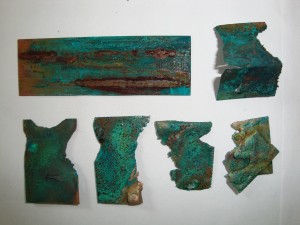
This project has urged me to continue to experiment with the process of evaporation in order to create interesting surfaces. I have created a few samples, whereby I set up certain conditions that allow a surface to create itself; often with a completely unknown and surprising outcome. One such experiment allows vinegar to evaporate and then to crystallise on the surface of copper, creating a sand-like texture, not dissimilar to under-fired enamel and with the most amazing colour.
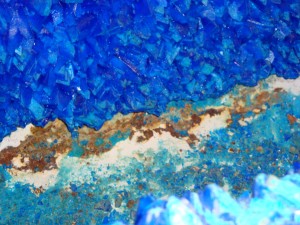
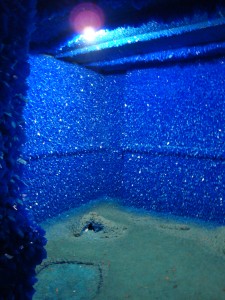
My inspiration for this originally came from a visit to Roger Hiorn’s Seizure, below, in which he coated the interior of a South London flat with blue crystals. Hiorn flooded the flat with 70,000 litres of hot copper sulphate solution, which was then left to cool and crystallise, creating an atmospheric, striking crystal cave. I loved the contrast between the tight constraints and rules that he had to follow in order to implement and facilitate the work, and the uncontrolled, unknown natural outcome.
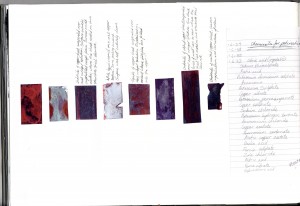
I have previously combined enamel and patina in order to create a similar effect, where the patina often creeps over the enamelled surface thereby altering the enamel’s appearance. Below are a few samples from my sketchbook.
Here are a few up-close photographs so you can see the surface texture and patina created simply from vinegar fumes.