Housing/Warehousing

I’ve been lurking at Heat Exchange2 for a while now, and after the latest request for a post, I decided to gather my thoughts on how my work was coming along.  
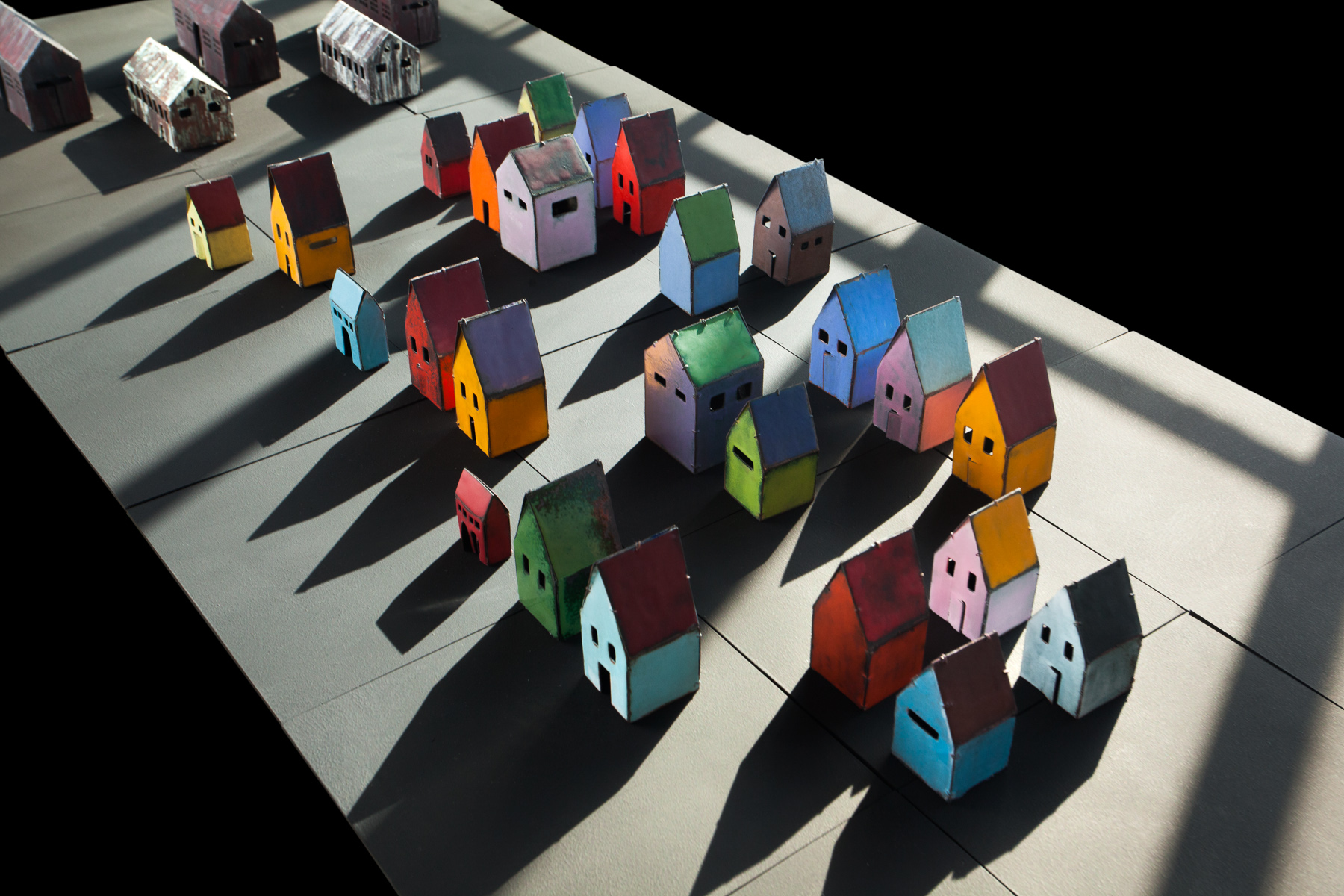
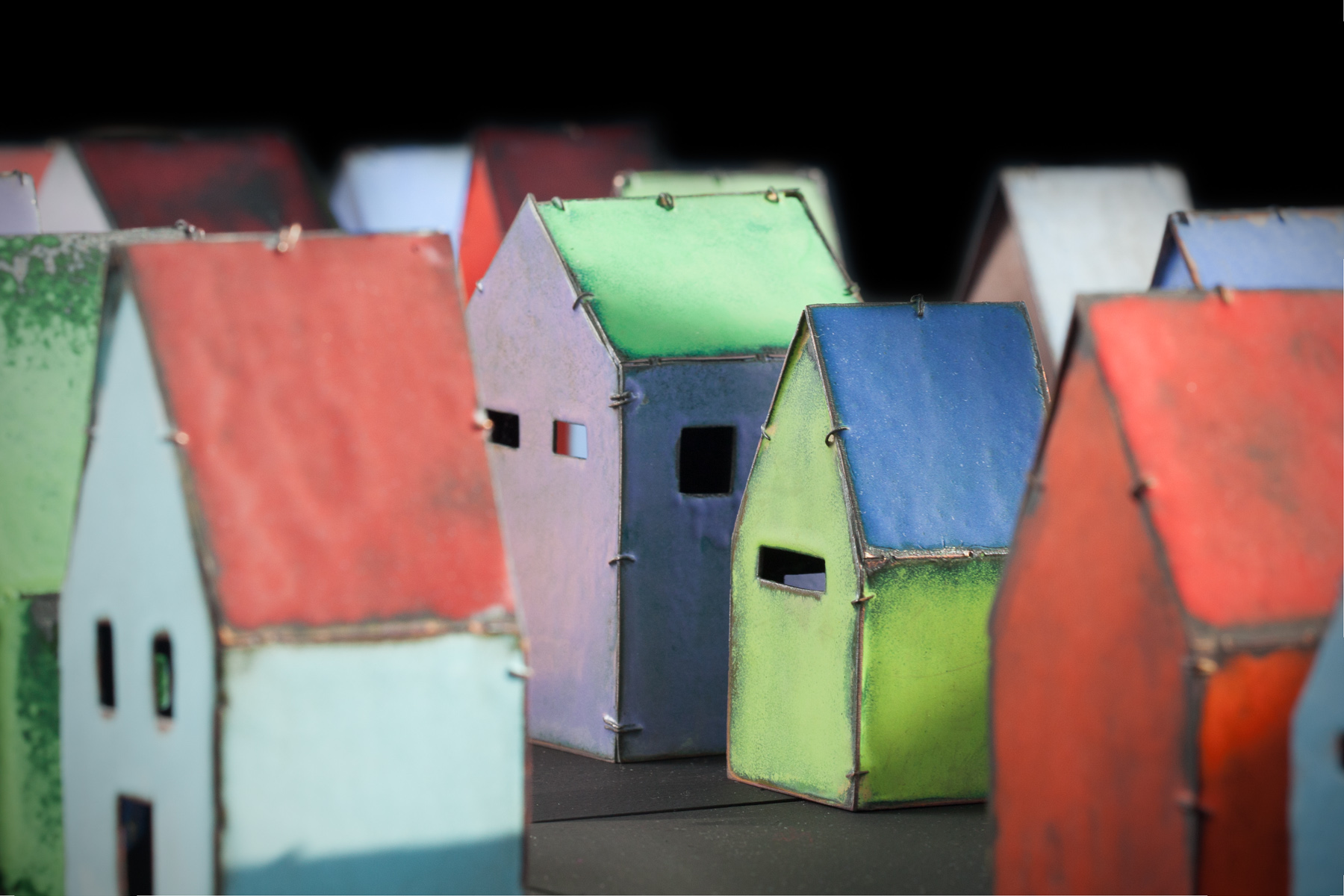
Housing/WarehousingHouses, detail

The inspiration for my installation “Housing/Warehousing” evolved over nearly a year’s time. Over the years I have returned to a house theme from time to time, sometimes for personal reasons, but also because home and shelter are universal themes. The sequence of events went something like this: At the Bauhaus Museum in Tel Aviv I saw  colorful workingmen’s houses designed by Bruno Taut, who was forced to leave Germany by the early 1930s. On a retreat I talked with woodworker Wendy Maruyama, who was beginning her monumental “Tag Project,” about the Japanese detention camps in the US during the same war. Investigating abandoned buildings I was struck by the similarity in structures used to house prisoners at Auschwitz and Manzanar.

I began constructing peaked-roof dwellings that were folded up from a single sheet of metal, using vitreous enamel to give a permanent, rich surface. Using wire to “stitch” them together at the seam gave a surgical as well as domestic subtext, and was a sign that they had been fabricated by hand.  Scaling up beyond jewelry made every one a technical challenge as I went along.  Recurring issues concerned using sifted or liquid enamel, often both; getting the right chalky, gouache-like surface; and the optimal relation between metal gauge and final dimensions.

Then an unexpected layer of meaning came into the work.   Riding the train from Munich to Dachau last spring, I noticed the landscape was dotted with small, colorful, peaked-roof houses, much like the ones I had been making. The geographical and cultural proximity of these structures tied together the two previously irreconcilable bodies of work.  Taut’s houses, while modest in scale, were full of life; barracks used to warehouse people are the opposite.

On yet another level, I had long tried to find a way to address the Holocaust in my work, but jewelry just wasn’t it. The opportunity and, yes, deadline of Heat Exchange2 enabled me to create the space to explore my own narrative.

 

Marjorie Simon

Marjorie Simon lives and works in the USA.

Hello 2015!

Hello, it has been a while. When I  received a notification-email, I  read the articles through emails and have been quite satisfied. But surely there is more, sorry! I have to get used to “exchange”. I still need to learn little more about the site to orientate myself with comments-things…

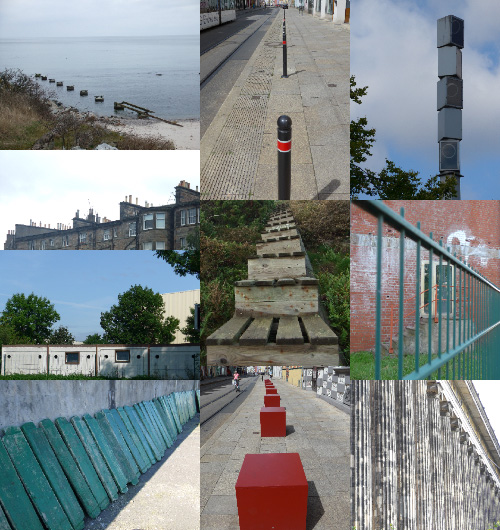
Meanwhile, as a new year has begun, I will start to put some so called “inspiration”- materials. I am not yet sure if they will be something. I almost never transform some exact inspiration directly into my work. But the layers of inspirations are effecting the process of making.

I get inspirations from all over,  so my layers of inspiration are not well organized. Some are factual, others are abstract. Please don’t ask me how they associate each other… I don’t know yet, either.

These are very concrete motives. Continuing, repeating, lining things often catch my eyes, though I haven’t be able to do so with my work, yet.

inspiration
inspiration

Colours are always inspiring.

inspiration
inspiration
inspiration
inspiration

Even more dense.

inspiration
inspiration
inspiration
inspiration

Enjoy your weekend!

Kaori

Kaori Juzu

Kaori Juzu lives and works in Denmark.

New enamel tests

Cooperation GARNISH pattern- tests

So I’m working on another exhibition at the moment, for which I’ve produced these sample squares of a new pattern. A friend of mine, the head of jewellery and objects at Slippery Rock University in Pensylvania, Sean Macmillan, got in contact with me to see if I would be interested in collaborating with him for the Co:operation GARNISH exhibition. This show, being curated by Rachel Timmins and Brigitte Martin, is meant to be a collaboration of unlike forces aimed at building links between a fairly disparate jewellery community here in the US. After some initial discussions about our suitability to pair up (we are technically both metalsmiths) we decided that a large-sculpture-making, techno-challenged academic in Slippery Rock and a delicate-jewellery-making, CAD-using, basement-studio-hermit from Australia now living in Seattle was about as different as we needed to be!

Ttrue to my usual method, I got straight into drawing a pattern in Cad, which we had both agreed over a long text-message conversation, needed to be ‘lacy’ (see images). And true to his, Sean soon texted me a mobile-phone image of his hand-built model, a roughly sketched and assembled pattern – in the way of a garment pattern –  made out of used computer-paper and masking-tape.

Cut to a few months later, and here are some images of the sample squares of pattern that I’ve had cut, checked out and then sent off to Sean to play with. (Notice the miscommunication with the laser-cutters resulted in the lead-ins being on the wrong side of the line – we’re after the sheet more than the ‘drop-outs’ in this instance as that’s what Sean will work with.)

Cooperation GARNISH pattern- tests Cooperation GARNISH pattern- tests Cooperation GARNISH pattern- tests

And here’s the first test works! These necklaces are in stainless steel and vitreous enamel with titanium hinge pins. As test pieces – a sort of proof of concept – I think they are pretty successful.

The actual part that will allow Sean to work his magic was signed off by us today, and will be cut by Pololu early next week. Once Sean has the pieces he will send me all of these inserts and I’ll have some more enamelling to do!

Cooperation GARNISH neckpiece- tests Cooperation GARNISH neckpiece- tests Cooperation GARNISH neckpiece- tests Cooperation GARNISH neckpiece- tests

Melissa Cameron

Melissa is a jewellery artist from Australia living in Seattle in the US. Her works can be found in the National Gallery of Australia as well as the Cheongju City Collection in South Korea. Her enamel works typically display subtle enamel incursions amidst precise laser cut stainless steel layers.