I’ve been lurking at Heat Exchange2 for a while now, and after the latest request for a post, I decided to gather my thoughts on how my work was coming along.
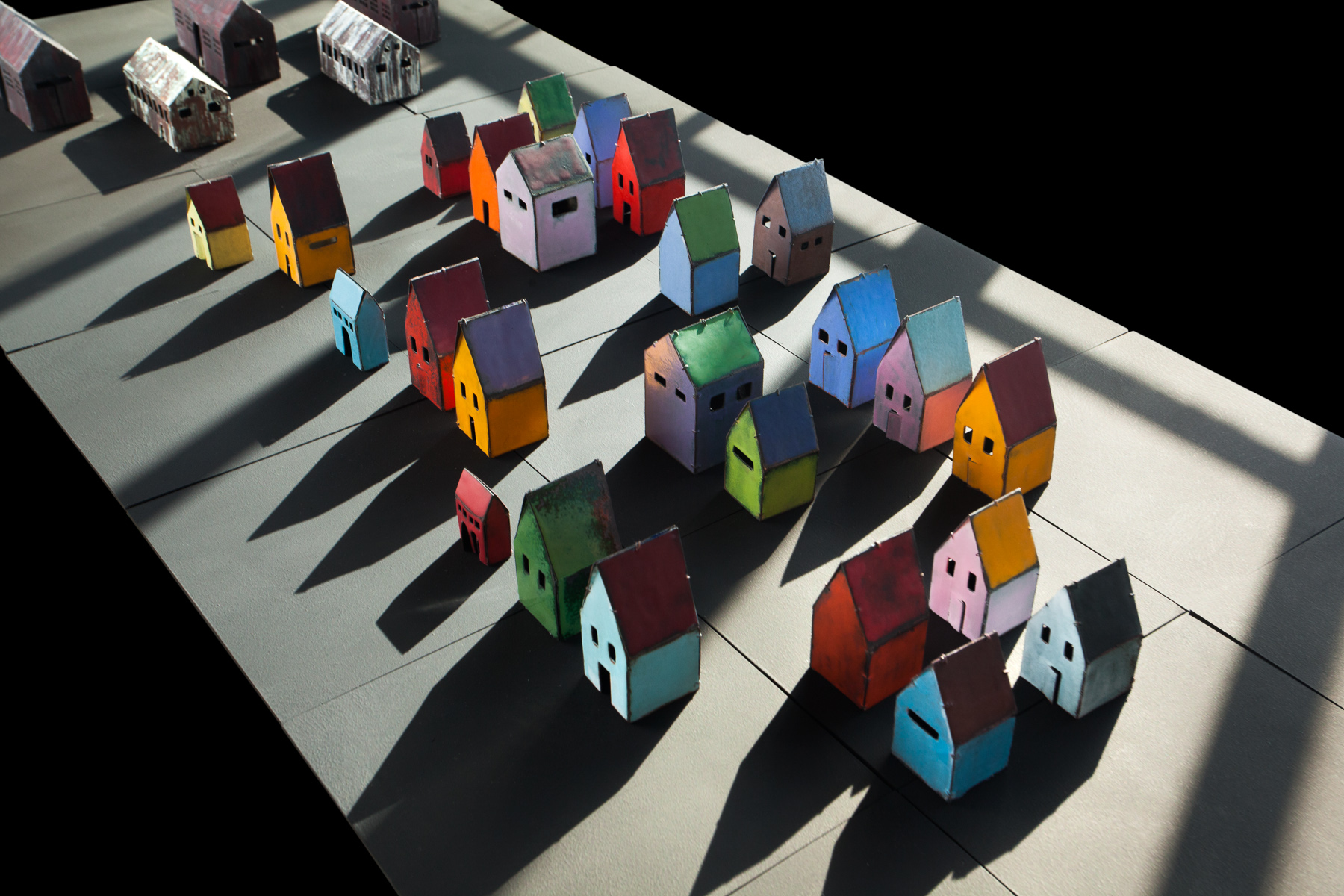
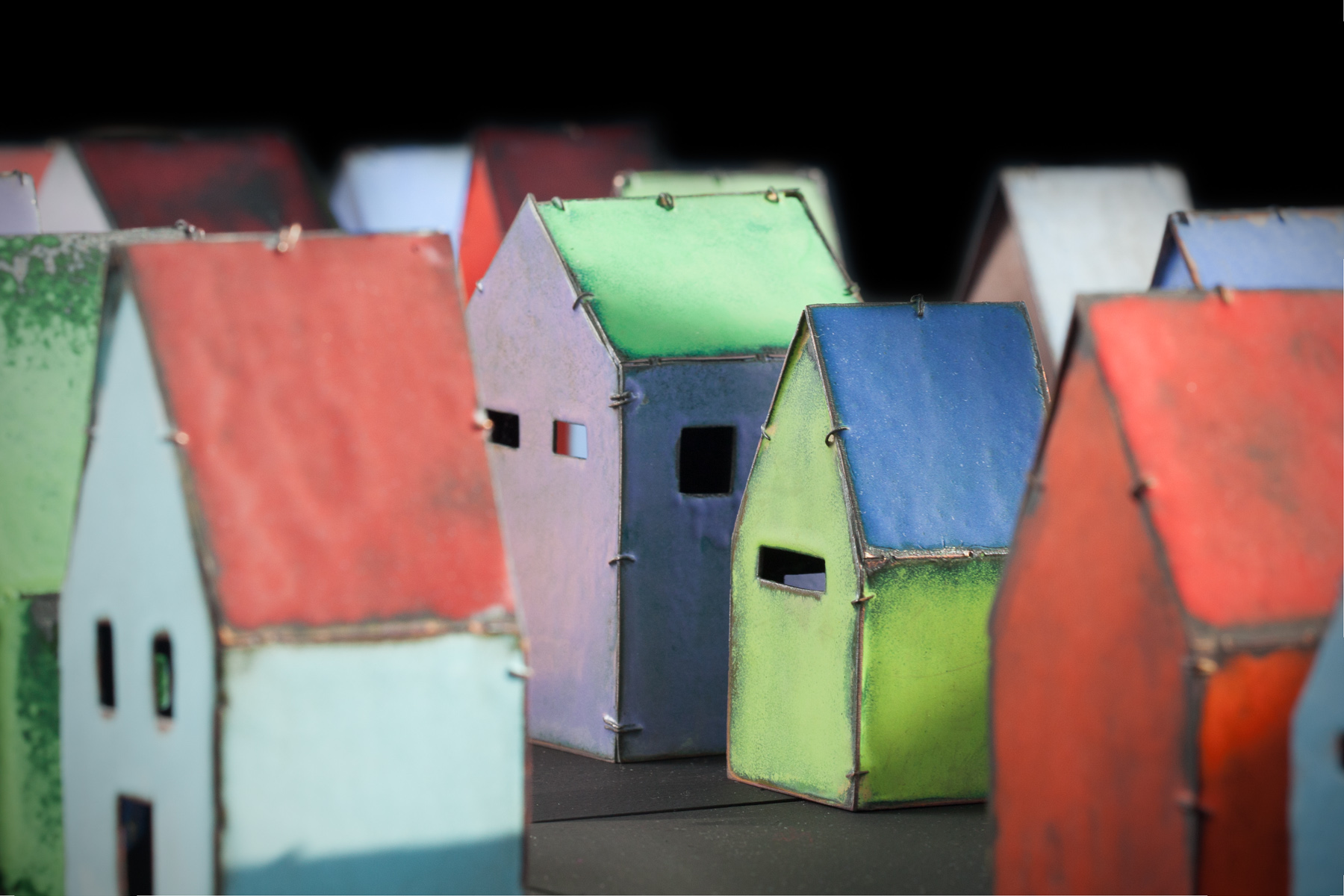
The inspiration for my installation “Housing/Warehousing” evolved over nearly a year’s time. Over the years I have returned to a house theme from time to time, sometimes for personal reasons, but also because home and shelter are universal themes. The sequence of events went something like this: At the Bauhaus Museum in Tel Aviv I saw colorful workingmen’s houses designed by Bruno Taut, who was forced to leave Germany by the early 1930s. On a retreat I talked with woodworker Wendy Maruyama, who was beginning her monumental “Tag Project,” about the Japanese detention camps in the US during the same war. Investigating abandoned buildings I was struck by the similarity in structures used to house prisoners at Auschwitz and Manzanar.
I began constructing peaked-roof dwellings that were folded up from a single sheet of metal, using vitreous enamel to give a permanent, rich surface. Using wire to “stitch” them together at the seam gave a surgical as well as domestic subtext, and was a sign that they had been fabricated by hand. Scaling up beyond jewelry made every one a technical challenge as I went along. Recurring issues concerned using sifted or liquid enamel, often both; getting the right chalky, gouache-like surface; and the optimal relation between metal gauge and final dimensions.
Then an unexpected layer of meaning came into the work. Riding the train from Munich to Dachau last spring, I noticed the landscape was dotted with small, colorful, peaked-roof houses, much like the ones I had been making. The geographical and cultural proximity of these structures tied together the two previously irreconcilable bodies of work. Taut’s houses, while modest in scale, were full of life; barracks used to warehouse people are the opposite.
On yet another level, I had long tried to find a way to address the Holocaust in my work, but jewelry just wasn’t it. The opportunity and, yes, deadline of Heat Exchange2 enabled me to create the space to explore my own narrative.
